Get Full Government Meeting Transcripts, Videos, & Alerts Forever!
Get email alerts on the Charter School Leases And Infrastructure topic
No spam. Unsubscribe anytime.
Lawmakers press committee on charter-school leases and off-site infrastructure; ask staff to draft bills
Summary
Committee members raised equity concerns about privately developed charter schools whose lease payments the state may fund, and discussed repeated off-site infrastructure costs tied to school siting. Senators and representatives voted to request a bill draft to make the 135% allowable square-footage rule permanent and to remove virtual students from that calculation; they also asked staff to explore infrastructure-coordination statutory language.
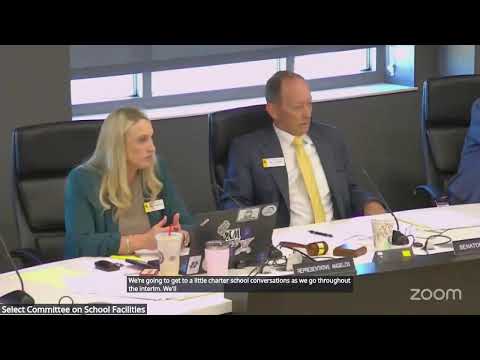
Lawmakers at the School Facilities Select Committee meeting pressed state staff Tuesday for clearer rules and earlier coordination on charter-school leasing and on local infrastructure demands that can sharply increase the cost of building public schools.
Several legislators, led by Senator Eric Rothfuss, said privately financed charter schools can create an inequity: a private developer builds a facility and the state ultimately pays a long-term lease based on average daily membership, leaving districts that follow the committee's normal capital process at a disadvantage. "It just feels like we've got an outlier," Rothfuss said, arguing the committee should consider ways to constrain or at least scrutinize the lease-driven pathway.
Shelby Carlson, school facilities division administrator, said the state does not simply pay the full lease amount requested by some charter operators. "We take the lesser of those two" — the lesser of the allowable square-footage calculation and the lease payment — she said, explaining the agency applies its allowable-square-foot calculator and reviews ADM (average daily membership) when determining payment.
The committee also spent substantial time on infrastructure problems that arise when districts acquire low-cost or only-available land. Director Del McOmie and staff described multiple examples where drainage, long sewer runs, pump stations, required turn lanes or city demands for event-scale parking and landscaping led to millions in additional costs beyond the building itself. In one case staff said a required signal or interchange near Greeley Highway would have been expensive enough that WYDOT agreed to absorb costs because the project affected broader traffic patterns.
Recapture agreements — arrangements where future developers reimburse earlier infrastructure investments — have produced modest statewide receipts in some districts, staff said, citing Natrona County's recapture that has returned about $3.699 million to the state or school accounts since 2010. But recapture is not a reliable universal remedy; agreements can lapse or developers may fail before repayments occur.
Committee actions: Senator Rothfuss moved that staff draft legislation to make the 135% allowable square-footage rule permanent and to remove virtual students from allowable-square-footage calculations. Representative Provenza seconded the motion; members approved it by voice vote. The committee separately asked staff to examine statutory language modeled in part on Utah law to require earlier district coordination with local governments on site selection and to limit excessive local requirements for landscaping, aesthetics or non-essential roadway work. Representative Haft seconded a motion to request exploration and drafting of infrastructure coordination language; the committee approved that request.
What happens next: staff will return bill drafts and supporting analysis in the next meeting cycle. Committee members asked the State Construction Department and planning stakeholders to work together to propose options that preserve essential safety and site requirements while limiting unanticipated, large off-site costs.