Get Full Government Meeting Transcripts, Videos, & Alerts Forever!
Get email alerts on the BIG Project topic
No spam. Unsubscribe anytime.
BNSF, City to release draft EIR for Barstow ‘BIG’ project as railway pledges $4 billion and workforce impacts
Summary
At a Barstow town hall, city officials and BNSF outlined the Barstow International Gateway (BIG) project: draft general-plan materials and a draft EIR will be released for a 45-day public review period before year-end; BNSF said the project represents a $4 billion investment with tens of thousands of direct and indirect jobs and a target construction start in 2026.
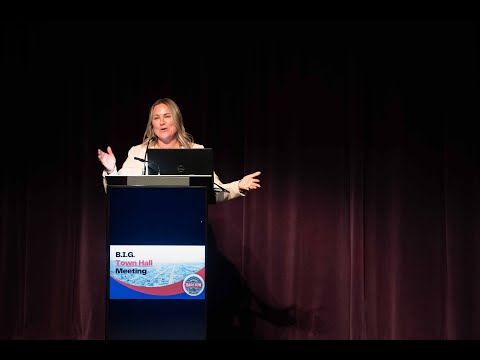
BNSF and city officials told a packed Barstow town hall that draft planning materials and an environmental impact report for the Barstow International Gateway (BIG) will be released for public review before the end of the year, beginning a 45-day comment period ahead of planning commission and city council hearings.
Ken Chapa, assistant city manager for the City of Barstow, opened the meeting and said the draft general plan, BIG-specific plan and draft environmental impact report would be available at City Hall, the public library and the city website and that written comments should be submitted to the Community Development Department during the 45-day review window.
"The draft general plan, BIG specific plan, and environmental impact report will be released for the public review by the end of this year," Chapa said, outlining the public-review steps that will precede public hearings.
PlaceWorks consultant Colin Ducker described the role of the general plan — the city's comprehensive long-term framework for land use, circulation, housing and public services — and explained that the BIG-specific plan will act as a detailed, site-specific implementation and zoning tool consistent with the general plan. Ducker said the EIR will analyze standard topical sections required under state environmental law and recommended that reviewers prioritize the executive summary, the project description and the findings subsections when the documents are posted.
"We're looking at an end state of the city nearly doubling in size," Ducker said, summarizing the large-scale modeling that the EIR will evaluate.
Lena Kent, general director of public affairs for BNSF Railway, described the BIG facility as a rail-first, closed-loop intermodal campus where containers would move by train from the ports of Los Angeles and Long Beach to the Barstow site, be transloaded in on-site warehouses and then be reassembled into domestic containers for onward rail movement. Kent said BNSF has acquired roughly 4,500 acres for the project and characterized BIG as intended to reduce truck miles, increase rail density and improve supply-chain efficiency.
Kent said BNSF now estimates the full project investment at about $4 billion, including the intermodal core plus warehousing and related infrastructure, and described a broader employment effect she said could reach roughly 20,000 direct and indirect jobs across construction and the local economic ecosystem. "This is actually a $4 billion investment that we'll be making in this community," Kent said. She added that the intermodal core had been described more conservatively at roughly $1.5 billion in earlier public materials.
On environmental commitments, Kent said the facility design includes battery-electric yard equipment ("hustlers"), hybrid-electric cranes and a planned on-site solar farm to help supply power for operations. She also described constraints on immediately electrifying long-haul locomotives, noting that tests of battery-electric locomotives have not yet met range needs and that earlier proposed statewide mandates to operate only battery-electric locomotives had been withdrawn by regulators; despite that, BNSF said it will include emissions-reduction measures in project design.
"One train can move anywhere from 280 to 400 trucks off the highway," Kent said, citing the rail-efficiency rationale behind the project.
Kent said the draft EIR will be published this year, responses to comments will be prepared and a final EIR will follow; she said BNSF hopes construction could begin in 2026 with an opening target of 2028 if local approvals proceed.
Next steps: the city will publish the draft materials and open the formal 45-day public comment period; the planning commission and city council will hold hearings on the final documents before any project approvals. Following the presentations, city staff, PlaceWorks, BNSF and Barstow Community College representatives remained in the lobby to take questions and accept public input.
Speakers quoted and paraphrased in this article are from the town hall and include Ken Chapa (assistant city manager), Colin Ducker (PlaceWorks), Dr. Ava Bag (Barstow Community College) and Lena Kent (BNSF Railway).