Get Full Government Meeting Transcripts, Videos, & Alerts Forever!
Get email alerts on the Sales Tax topic
No spam. Unsubscribe anytime.
Tennessee Revenue webinar: auctioneers liable for sales tax if sellers are undisclosed, department warns
Summary
Tennessee Department of Revenue experts told auctioneers that when owners are not disclosed to bidders the auctioneer is legally treated as the seller and must collect and remit sales tax; presenters also covered documentation, nexus, licensing classes and online-sale sourcing.
Jeremy Cain, a taxpayer-education specialist with the Tennessee Department of Revenue, told auctioneers in a department webinar that when an owner is not disclosed to bidders the auctioneer "shall be deemed the owner thereof" and therefore must file returns and remit sales tax. "Every auctioneer or agent acting for any unknown or undisclosed principal ... shall be deemed the owner thereof," Cain said, reading the department rule that frames the agency's guidance.
The webinar, presented by Cain with Billy Trout (Taxpayer Education) and Thomas Meisenzahl (Audit division), laid out practical steps auctioneers should take to avoid unexpected tax liability: clearly identify owners in print and online advertising, verbally announce owners at the auction (and item-by-item when multiple owners are involved), and keep written documentation such as bills of sale or disclosure agreements. "Document as much as you can," Meisenzahl advised; Trout added, "Document that big time" when collecting tax or acting on behalf of a seller.
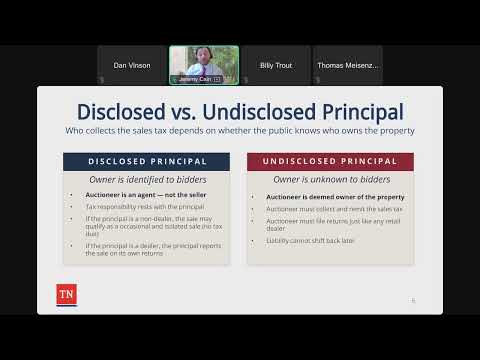
Panelists explained the difference between disclosed and undisclosed principals: if the owner is identified to bidders the auctioneer is an agent and tax responsibility generally rests with the principal; if the owner is unknown the auctioneer is treated as the dealer and must collect sales tax. The department also noted that certain occasional or isolated sales (for example, a one-time garage sale or short-term fundraiser) may qualify for exemption if they meet statutory limits (typically no more than two selling periods per year and no more than 30 days per period, per the presenters).
On sourcing and rates, Cain said Tennessee's state sales tax rate is 7 percent and local-option rates can add up to 2.75 percent. For an in-person sale where the auctioneer is treated as the seller, the applicable local rate is the auctioneer's place-of-business jurisdiction (panel example: Franklin 2.75%); for shipped items the destination (buyer's delivery address) governs local sourcing (panel example: Pikeville 2.25%). Cain illustrated the difference with a hypothetical: Franklin-based auctioneer selling an undisclosed item that ships to Pikeville would apply Pikeville's local rate.
The presenters covered business-tax and licensing implications as well. When acting as agent for a disclosed owner, the auctioneer reports only commissions and fees for business tax purposes; when the auctioneer owns and sells items, gross receipts include full proceeds (including commissions). Panelists described classification by dominant business activity: class two typically covers general tangible goods (retail rate example given 0.15%), class three covers art/antiques (retail rate example 0.1875%), and a wholesale rate of 0.0375% applies to qualifying wholesale activity.
On nexus and out-of-state activity, Meisenzahl said factors that can create Tennessee nexus include physical presence (office, warehouse, employee), inventory stored in Tennessee, agents regularly soliciting business in-state, systematic in-state auctions, or meeting the economic threshold (panel referenced $100,000 in Tennessee sales in the prior 12 months as a relevant benchmark). "Doing business is any activity purposefully engaged within Tennessee by a person with the object of gain," Cain said when describing the department's test for nexus.
In question-and-answer exchanges, the panel cautioned about collecting tax "on behalf of" a seller: auctioneers can collect tax for a client, but should verify the client's tax status and document the arrangement in contract language because refund claims can be difficult if later challenged. Meisenzahl also clarified pickup and delivery rules: if the buyer is required to pick up an item in Tennessee, possession occurs in-state and sales tax is due; some title/registration items (aircraft, boats, motor vehicles) have specific three-day affidavit procedures.
The department pointed attendees to resources on TN.gov/revenue (Taxpayer Education → tax webinars), the auctioneer and consignee tax manual, the sales-and-use tax manual, and the business-tax manual. Cain provided a contact email (revenue.support@tn.gov) and the general tax line (615-253-0600) for follow-up questions, and closed by listing upcoming webinars and reminding attendees to complete the post-event survey for CPE credit.
The webinar's guidance centers on two practical takeaways: make ownership status transparent to bidders to avoid being treated as the seller, and keep written documentation that spells out who paid or assumed tax obligations.