Get Full Government Meeting Transcripts, Videos, & Alerts Forever!
Get email alerts on the Charter Mayor Powers topic
No spam. Unsubscribe anytime.
San Bernardino charter committee moves to fast-track stronger mayoral powers and consider term limits for November ballot
Summary
The Charter Review Committee voted to hold a special meeting to draft charter amendment language aiming to strengthen the mayor's policy role (agenda powers, staff, nomination role, possible line-item veto) and to add term limits for mayor and council to the draft agenda; staff advised the committee on legal deadlines and outreach options.
The San Bernardino Charter Review Committee voted on a plan to accelerate work on proposed charter amendments that would give the mayor more formal authority and to add a term-limits proposal for consideration for the November ballot.
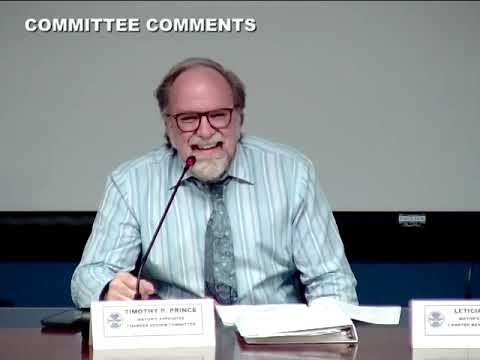
Chair Tim Prince proposed a package of changes intended to strengthen the mayor's policy role, saying the mayor should be able to place items on the council agenda, have a larger dedicated staff, recommend (nominate) a city manager for council confirmation, and possess a line-item veto on budget items. "The mayor needs to be able to directly place items on the agenda," Prince said, arguing those steps would increase accountability and leadership.
The committee heard a staff briefing summarizing how mayoral powers vary across California. A city manager representative said their research, citing a Rose Institute survey of California cities, found 38% of incorporated cities directly elect their mayor and only a handful operate under a "strong mayor" model; staff used that context to lay out operational considerations for the committee's proposals.
Public commenter Omar Williams, running for first-ward council, urged term limits and asked how to get a measure on the November ballot. Williams proposed four-year terms with either a two-term (8-year) or three-term (12-year) limit for councilmembers and the mayor and asked the committee to treat term limits as a standalone ballot item. "That gives the voters an option for more other candidates," Williams said during public comment.
Committee members debated whether term limits could be made retroactive. One member cited Government Code 36502 and an Attorney General opinion (11-41) as reasons retroactivity is legally constrained; staff said they would prepare a brief legal memo for the committee. The committee agreed to add a term-limits proposal to the special meeting agenda and to return on June 10 (tentative) to draft language and resolve legal questions.
On timing and procedure, staff explained the calendar for November: if the council ultimately places a measure on the ballot the adopted resolution must be filed with the county in time for the early-August ballot-printing deadlines, and typical staff report and agenda preparation runs about a month. Staff cautioned the committee that meeting scheduling, council agenda deadlines and Brown Act rules require tight coordination but said it was feasible with special meetings and rapid follow-up.
Members also discussed public outreach. Staff estimated that printing and stuffing an informational questionnaire as an insert to the municipal water bill (about 48,000 households) would cost roughly $3,000 (printing ~ $2,600 and ~$500 stuffing). The committee agreed to use the special meeting to draft language and to hold a public workshop at the June 24 regular meeting to solicit public input and "plant seeds" in the community, with staff to support publicity and televising.
Procedural votes recorded in the meeting included approval of the prior meeting minutes (a voice vote with one abstention by a member who was not present at the prior session) and a motion to set a tentative special meeting in early June to begin drafting the charter language. The committee did not adopt final charter language at this meeting and no ballot placement decision was made; next steps are drafting proposed language, receiving legal review, conducting public outreach and, if the council agrees, taking a resolution to the county by the required deadlines for November.
The committee adjourned after confirming the June meeting targets and outreach plan.