Get Full Government Meeting Transcripts, Videos, & Alerts Forever!
Get email alerts on the Charter Schools topic
No spam. Unsubscribe anytime.
Applicants propose K–8 ‘Community Charter School of the Arts’ in Bethlehem with 1,125 seats and community arts center
Summary
At a May 27, 2026 hearing, applicants presented plans for a K–8 Community Charter School of the Arts to open in 2027–28 at 1640–1660 Valley Center Parkway, proposing 1,125 seats, an on-site community arts center in year two, partnerships with local arts institutions, and lottery-based admissions; the district declined to accept late curriculum materials and recessed the hearing to June 15, 2026.
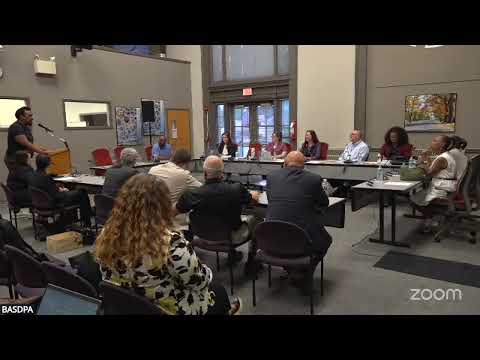
Good evening. Community Charter School of the Arts representatives presented their opening application to the Bethlehem Area School District Board of School Directors on May 27, 2026, proposing a K–8, arts-integrated public charter school to open in the 2027–28 school year with a capacity of 1,125 students at 1640, 1650 and 1660 Valley Center Parkway.
Allison Peterson, an attorney with Whistler Pearlstein serving as legal counsel for Bethlehem Area School District, opened the hearing and summarized the statutory timetable under the charter school law, telling the room that the board must take action on the application no later than Aug. 10, 2026. "Under the charter school law...the final decision of the board must be made no later than 75 days after the first public hearing," Peterson said during the presentation of hearing procedures.
Crystal McCullum, introduced as the applicant’s proposed principal, said the project would replicate the applicant’s existing arts-integrated model and expand it for K–8 enrollment. McCullum described a phased facility plan using two buildings in year one and fitting out a third building in year two to add a gymnasium, cafeteria, auditorium and a separate community arts center. "We are proposing a new charter school...directed at the community," McCullum said, noting partnerships the school says it already has with local institutions.
Danielle Jurro Salaja, identified as director of arts integration, described an artist-residency model and curricular partnerships with local museums and performance venues. "Artists are the ultimate change makers," Jurro Salaja said, explaining that resident artists would be invited to collaborate with teachers, lead workshops for the public and use dedicated studio space that would be scheduled to protect student safety.
The applicants identified several local collaborators in their slide materials and testimony, including the Tanner Museum, Miller Symphony Hall, the Allentown Art Museum and Lehigh University Arts Gallery. A museum representative who spoke in support described a recent schoolwide student exhibition and the partners’ role in co‑creating curriculum and professional development for teachers.
On academics and admissions, presenters said the school would provide daily arts rotations (visual art, music, dance, theater, creative movement), integrated instruction, one instructional support teacher per grade, MTSS/Encore supports and a middle-school block schedule. The applicants said the school will not audition students and will run a public lottery with Bethlehem Area School District residents receiving statutory priority.
Board members extensively questioned the applicant about governance and the relationship to Arts Academy Elementary, an existing Allentown charter school the presenters said they are "replicating." Applicant counsel said the new charter would be a separate Pennsylvania nonprofit with its own EIN and operating board, but several founding coalition names listed in the application match current Arts Academy board and administration. Board members pressed whether staff or board members would serve both entities and whether any Arts Academy students would receive enrollment preference; the applicants said they expected many administrators to move to the new school but that admissions would follow lottery and statutory priorities.
District officials also probed finances and operations. Thomas Taylor, who identified himself as the budget preparer and business manager, walked the board through the pro forma where year‑one technology costs are detailed (technology infrastructure $300,000; classroom technology $500,000; office technology $125,000). Taylor said year-zero costs will be covered with a combination of private financing, startup grants and landlord work where possible and that the landlord has agreed to perform substantial fit‑out as part of the lease arrangement.
A procedural dispute arose near the end of the hearing when the applicant attempted to submit 11 copies of materials described as missing from the original filing: a K–8 technology curriculum and middle-school arts-enrichment/social-studies materials. Applicant counsel said the omission was accidental and offered the materials for the record. District counsel said supplemental materials had been submitted by the stated deadline and declined to accept these late copies into the formal application record, noting the application is expected to be complete upon submission. The applicant placed copies with the court reporter for the record and objected on the record to the district’s refusal.
During the public-comment period, multiple Bethlehem residents and district parents and staff spoke in support of the application, citing the impact of arts programming on student engagement and social-emotional development. Speakers who identified themselves as residents or taxpayers included a kindergarten teacher and parent, the landlord of the proposed site and local teaching artists.
The board recessed the hearing and will reconvene for a second public hearing, expected the evening of June 15, 2026, at which the district administration will present its evaluation and the board will continue questioning. "This hearing will be held in recess until we reconvene at the next hearing, which is anticipated to be on the evening of June 15, 2026," district counsel Mr. Pennock said.
Next steps: the board will accept written materials and the district will circulate its evaluation ahead of the second hearing; the board must take final action by Aug. 10, 2026 under the timeline announced at the May 27 hearing.