Get Full Government Meeting Transcripts, Videos, & Alerts Forever!
Get email alerts on the Public Safety Fee topic
No spam. Unsubscribe anytime.
North Bend staff flag implementation gaps in public safety fee, council asks for revised plan
Summary
City Manager Dunham told the City Council an internal audit found the public safety fee has been implemented "per meter" rather than the ordinance's "per unit" language; staff outlined options (occupancy reporting for hotels, special treatment for mini-storage and group homes) and the council asked staff and the city attorney to return with a refined implementation plan before notices go out.
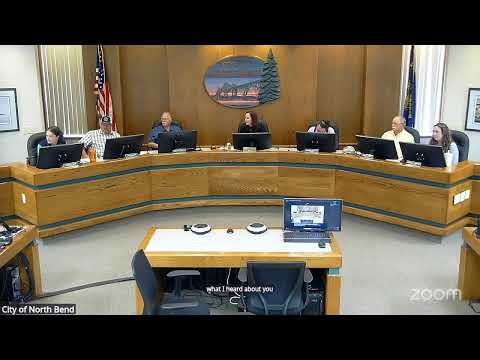
City Manager Dunham told the North Bend City Council on May 26 that an internal audit found the city's public safety fee has not been implemented as the ordinance intended. "We have been doing an audit'of our public safety fee primarily after we discovered that our current ordinance was not properly implemented," Dunham said, explaining staff had repeatedly interpreted billing as "per meter" rather than "per unit."
Dunham said staff had identified locations that may have been undercharged and that the discrepancy first drew attention after a resident's query. "When we started looking at the public safety fee again, I sort of redressed that," Dunham said. He told council that if the fee were applied strictly by the ordinance's language—per occupied unit—some accounts could see large increases. As an example, staff said a 107-unit complex now paying about $30 a month under a meter-based approach would face roughly $2,140 a month if billed on occupied units.
Staff presented specific implementation options to limit sudden bill shocks. For hotels, staff proposed using the industry STAR lodging report to set an annual occupancy-based billing figure: "If you have 100 units but you only have say 49% average occupancy... it makes sense that we charge them based on 49 units because that's their average," the staff presentation said. Hotels would need to submit the report annually or default to 100% for billing.
Councilors and staff also identified several ambiguous cases. Mini-storage, small licensed group homes and assisted-living arrangements raised questions about whether each storage unit or bedroom should be counted as an "occupied unit" or treated as a single commercial operation. "Storage units get a little muddy," a council member said; staff recommended either an official interpretation or ordinance amendment for those categories.
Council discussion focused on equity and the ordinance's spirit. Several councilors said the fee was intended to let everyone share the cost of public safety proportionately and questioned whether meter-based billing produced inequities. Councilors debated monthly fee versus property-tax funding and asked staff about practical billing problems, such as buildings with multiple living units served by one meter or meters shut off for vacancies.
Rather than immediately sending notices or fully applying the auditor's findings, councilors agreed staff and the city attorney should refine the implementation approach and return with language and a rollout plan. Dunham said staff planned to mail letters to affected customers and suggested July 1 as a possible implementation date only after council direction: "We wanted to give you sort of an update presentation and then... go over some of the sort of implementation plans that we have."
Next steps: staff will work with the city attorney to produce recommended interpretations or ordinance amendments, coordinate with the water board to verify meter and fee data, and return to council with a proposed implementation schedule and communications plan before any changes are finalized.