Get Full Government Meeting Transcripts, Videos, & Alerts Forever!
Get email alerts on the Groundwater Management topic
No spam. Unsubscribe anytime.
Board adopts amended resolution on minimal-impact exclusion after staff presentation and rural comments
Summary
The State Water Resources Control Board adopted an amended staff resolution advancing a minimal-impact exclusion and related reporting rules for several groundwater sustainability plans after a staff presentation on GSP revisions and public comment from small‑farm advocates and local GSAs.
Natalie Stok, director of Sustainable Groundwater Management staff, told the State Water Resources Control Board that staff had reviewed revisions to multiple groundwater sustainability plans (GSPs), described expanded monitoring, and recommended the board advance an amended resolution setting criteria for minimal‑impact exclusions and related reporting.
The recommendation followed staff presentations on Delta Mendota and other subbasins, including multi‑year groundwater‑pumping figures and an explanation of updated minimum thresholds, monitoring expansions and a domestic‑well mitigation policy. Stok said the state review began in March 2023, draft GSPs were circulated with public comment in 2024, and staff issued a March 2026 assessment that opened a 30‑day comment period.
Why it matters: the resolution sets criteria GSAs will use to determine when smaller extractors may be excluded from fuller reporting requirements — and it frames the board’s oversight and the technical support GSAs will need. Staff emphasized that the aim is to avoid “undesirable results,” protect critical infrastructure and wetlands, and provide mitigation pathways for impacted domestic well users.
Public commenters representing small‑farm networks, university extension programs and irrigation districts largely supported a streamlined exclusion for very small extractors but urged changes to reduce administrative burdens and fees. Lois Paniava, who identified herself as working with University of California agricultural and small‑farm programs, asked the board to “remove or reduce reporting and fee burdens for very small extractors,” arguing the current design would impose disproportionate costs on limited‑resource operators and noncommercial smallholders.
Other commenters — including a GSA chair who said he represents a central Delta GSA — praised coordination among 23 GSAs in the region but flagged technical and data gaps and asked for clearer definitions of proximity rules (for example, the two‑mile fronting‑canal criterion) and how total extraction would be calculated for exclusion eligibility. Several speakers urged stronger outreach, language access, and technical assistance so small operators can comply without undue cost.
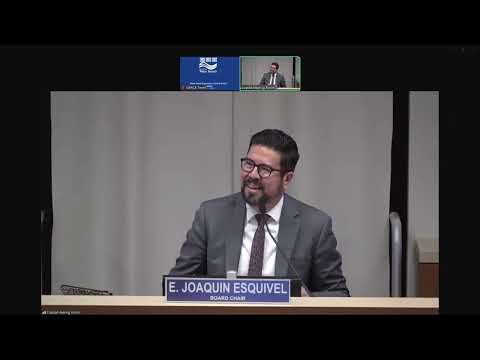
Board discussion focused on statutory authority and on clarifying how the exclusion will be applied. Members and staff referenced Water Code provisions discussed in the staff materials as the legal basis for exclusions and annual reporting windows. After board members read and described the amendments on the record, the chair said the resolution as amended was adopted. The transcript does not include a roll‑call tally or named vote results.
What happens next: staff will work with GSAs to implement the amended criteria, provide requested data to interested parties, and return with further refinements as needed. The board moved to the next agenda items and took a lunch recess.
Sources: staff presentation and public comment recorded in the meeting transcript; Water Code citations and staff assessment referenced on the record.