Get Full Government Meeting Transcripts, Videos, & Alerts Forever!
Get email alerts on the Diversion Permit topic
No spam. Unsubscribe anytime.
Aquarian seeks 25-year diversion permit after pump test shows 186,000 gpd maximum-day yield
Summary
Aquarian Water told Marlborough residents it is pursuing an individual 25-year diversion permit after a 72–145-hour pump test indicated a maximum-day yield of 186,000 gallons; the company said the permit is required because projected growth and current developments could push system demand above the 50,000-gpd threshold that triggers permitting. Residents raised concerns about private wells, monitoring scope and water quality; Aquarian said third-party monitoring showed no observed impacts for monitored properties and directed comments to the state permitting process.
Aquarian Water representatives told Marlborough residents they are applying for an individual water diversion permit after pump testing showed a tested maximum-day yield of 186,000 gallons per day, a level company engineers said is needed to give the system a 25-year planning horizon and comply with state rules.
"Aquarian as a regulated water utility cannot promote growth," said Dan Lawrence, Aquarian vice president of engineering and real estate. He said the company filed for an individual permit because Connecticut permits grant a 25-year term for individual applications compared with 10 years for a general permit, and because the system is approaching the 50,000-gallons-per-day statutory threshold that triggers the diversion-permit requirement.
Why apply for 186,000 gpd? Lawrence said the figure comes from a sustained 72–hour pump test (a multi-day stabilized test required by state regulators) that established a maximum-day yield for the wellfield. "Out of our pump test we were able to get a sustained ... water that could come out of 186,000 gallons a day," he said, and added that the 186,000 number represents a tested maximum-day capacity, not the amount the company expects to pump every day.
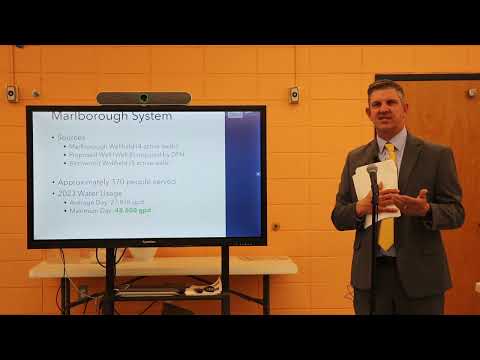
Aquinas' officials described the Marlborough wellfield as having four active wells and noted the Department of Public Health required the company to add redundancy (an additional production well, No. 8) so the system can continue to supply customers if one large well is lost. Lawrence said Aquarian serves roughly 150 accounts (about 370 people) in Marlborough and that pending or proposed developments — including a 96-unit apartment project estimated to add 8,000–12,000 gallons per day on average — are among the factors that could push the system over the 50,000-gpd threshold in coming years.
Residents asked whether pump tests that run for several days can reliably detect impacts to nearby private wells. One resident recounted earlier experiences of intermittent private-well shortages and asked what protections Aquarian would offer to neighbors if private wells were affected. Lawrence said Aquarian hires an independent third-party groundwater consultant to run and witness tests, installs level transducers and monitors both system and some private wells as required by the testing plan submitted to the state. "We put level transducers in the wells both in the private wells ... they're out there to witness the test and they have to basically certify the test," he said. Company representatives said the test data in the application and monitoring for the monitored properties showed no observed interference.
Several residents noted that not every nearby private well had been monitored in prior tests. Aquarian acknowledged the monitoring plan does not always include every adjacent residential well and said monitored locations referenced in past tests included specific East Hampton Road addresses and community facilities. The company pointed residents to the application on the state site for the consultant's report and monitoring data.
Residents also asked whether Aquarian could or would truck water to other towns or extend service outside established service areas. Aquarian representatives said existing agreements and public-utility rules limit extensions and that the company does not plan to extend routine service outside agreed boundaries; they said some mutual aid (truck delivery) can occur in emergencies as long as doing so does not hinder Marlborough service.
Lawrence stressed that state regulators — not the town meeting — make the diversion-permit decision and encouraged residents to submit comments to the Department of Energy and Environmental Protection and the Department of Public Health. He also summarized built-in reductions that regulatory review requires (a drought-related reduction and a long-term reduction factor applied to test yields) and closed by offering follow-up contact information.
The session was informational; no local vote or permit decision happened at the meeting. Aquarian said the application and supporting studies are available for public review through the state permitting portal and invited residents to raise specific monitoring or water-quality concerns with the company and regulators.