Get Full Government Meeting Transcripts, Videos, & Alerts Forever!
Get email alerts on the Mvp Program Overview topic
No spam. Unsubscribe anytime.
Massachusetts unveils MVP 2.0 grants to move communities from climate planning to action
Summary
The Executive Office of Energy and Environmental Affairs detailed MVP 2.0, a two-year resilience program that pairs communities with equity partners, funds core teams and seed projects with $50,000 for planning and $50,000 for implementation (baseline $100,000), and emphasizes paid community liaisons and social resilience.
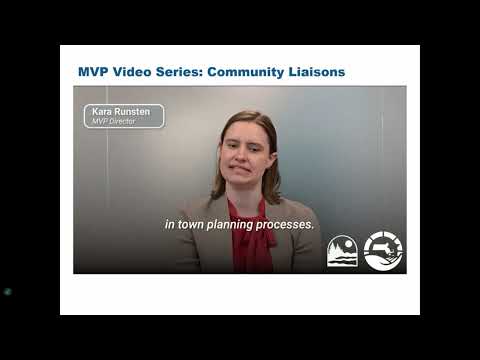
Kara Runsten, MVP program director, opened the webinar by describing MVP 2.0 as "a program that continues to support Massachusetts communities in increasing resilience to climate change by building off of and filling gaps from the One Point O program," with a new emphasis on equity and translating priorities into action.
The program is a two-year process. Runsten said the first year focuses on developing a core team and revisiting resilience priorities with broader community involvement; the second year centers on implementing a seed project that advances those priorities. Each participating community or regional partnership will be paired with an equity partner hired by EEA to lead learning sessions and help center equity and climate justice in the work.
Runsten outlined core-team composition and vendor roles. Core teams are expected to be roughly 10 people, about half community liaisons and half municipal staff or partners. Community liaisons—individuals with ties to environmental-justice and priority populations—are to be compensated from grant funds; communities may pay liaisons directly through municipal payroll or via the planning vendor as a subcontracted role. Planning vendors will be procured by the municipal lead; the program provides a sample RFP, qualifications and a list of vendors that have expressed interest but cautioned that appearing on that list does not guarantee qualification.
The seed project is intended as a near-term, implementable project that can be completed in roughly nine to ten months. Runsten said communities receive $50,000 for steps 1–8 and 10 and another $50,000 to implement the seed project, for a baseline total of $100,000; applicants may also request additional funds for translation and interpretation. Pilot examples shown in the webinar included an educational forest on town-owned land, food-security and sustainable-land-management projects, energy-efficiency window inserts, and youth climate leadership efforts.
Why it matters: Runsten and pilot participants emphasized that MVP 2.0 aims to bridge the frequent gap between planning and implementation by building community capacity, paying local liaisons for outreach and producing small, actionable projects that can make communities more competitive for larger action grants later.
Next steps: Runsten said the request for responses (RFR) and application materials were expected to be posted in the coming days, with applications due in December and projects running into December 2027. Questions about Two Point O can be sent to mvp@mass.gov or to regional coordinators; the webinar recording and slides will be posted on the EEA website.