Get Full Government Meeting Transcripts, Videos, & Alerts Forever!
Get email alerts on the Land Use Cannabis Permit topic
No spam. Unsubscribe anytime.
Lake County supervisors uphold planning commission approval for Rancho Lake cannabis project, deny neighbor's appeal
Summary
After hours of testimony over water, biology and odor risks, the Lake County Board of Supervisors voted 4-1 to deny an appeal by neighbor Peter Lucetti and uphold the planning commission's Jan. 8, 2026 approval of a major use permit allowing 19.66 acres of outdoor cannabis cultivation at Rancho Lake/Comtock Ranch; staff will prepare formal findings for return within the required period.
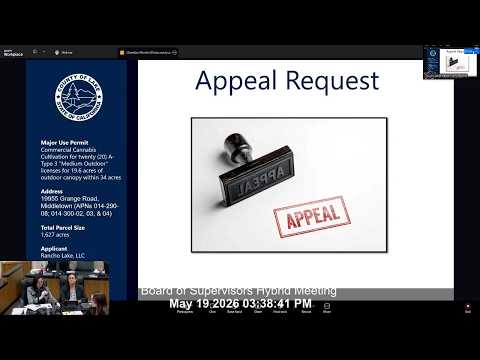
The Lake County Board of Supervisors on May 2026 denied an appeal by neighbor Peter Lucetti and upheld the planning commission's January approval of a major use permit for Rancho Lake LLC that would allow about 19.66 acres of outdoor commercial cannabis cultivation on a 1,627-acre ranch near Middletown.
Mary Claybon, senior planner for the county's Community Development Department, told the board that the planning commission adopted a mitigated negative declaration on Jan. 8, 2026 and that staff had found the project consistent with the Lake County General Plan, Middletown Area Plan, applicable zoning and Department of Cannabis Control regulations. "All identified impacts are reduced to less than significant with mitigation measures incorporated," Claybon said during her presentation.
The project would locate approximately 19.66 acres of outdoor canopy within a 34-acre cultivation area, and the permit package includes five seasonal 6,000-square-foot engineered membrane drying/storage structures, several small sheds for chemicals and office/security, about 20 5,000-gallon irrigation tanks, security fencing, internal roadway improvements and an employee parking area. Staff reported an estimated annual water use of about 49.2 acre-feet and said the site meets the required setbacks from mapped watercourses.
Why it mattered: Appellant Peter Lucetti and his counsel argued the environmental review was inadequate and that the record left open fair arguments under the California Environmental Quality Act (CEQA) that the project could cause significant impacts to groundwater, biological resources, traffic/evacuation and neighboring organic agriculture. "We are not in opposition to the cannabis industry," Lucetti said. "We're asking the board to put appropriate protections in place for traditional agriculture in Lake County." He raised concerns about hydrology, pesticide drift and potential effects on his certified-organic operation.
Expert exchanges: The hearing included competing technical testimony. Ryan Crawford of GHD testified for the appellant that long-term records show groundwater declines in the Coyote Valley basin and that the applicant's six-hour pump test and modeling lacked observation wells and longer-term data to rule out impacts on neighboring wells. "Long-term trends since 1950 show it's generally declined almost 10 feet," Crawford said, adding that his transducer monitoring on Lucetti's wells showed interactions that raised concern about neighboring well interference.
The applicant's certified hydrogeologist, Lee Hervitz of Hervitz Environmental, replied that the site-specific hydrogeologic assessment, modeling and field data supported the conclusion that project pumping is reasonable, produced small predicted drawdowns and that measured recoveries following tests were rapid. Hervitz said observed drawdowns in appellant-run transducer tests were created by much higher pumping rates (650 gpm) than the project proposes and that project modeling predicted less than a 3% drawdown in typical scenarios.
On biology, Eric Smith, retained by the appellant, said botanical and wildlife surveys were incomplete or performed during drought conditions, and that protocol-level planning surveys and a wetland delineation were needed to address candidate species (he cited Crotch's bumblebee and the recently proposed listing of the northwestern pond turtle). "Preconstruction surveys are not the same as protocol or planning surveys," Smith said, arguing that some areas (notably access roads) were not covered by later survey efforts.
Applicant counsel Timothy Cassuni defended the administrative record, saying it contains multiple biological surveys, an April 2026 preconstruction check and empirical pumping data supporting the mitigated negative declaration. "The county has substantial evidence supporting its conclusion that groundwater impacts would be less than significant," Cassuni said.
Community split and concerns: Public comment showed division. Several nearby residents and ranching neighbors described past illegal grows and worried about pesticide drift, odor and road safety; others, including local agricultural consultants and supporters of the Comtock family, urged the board to uphold the process and allow the project, describing the site as previously farmed and well-suited to cultivation.
Board decision and next steps: After questioning and deliberation, supervisors moved to deny the appeal (a motion to "deny appeal PL-26-12, upholding the planning commission's approval of PL-25-13 and adoption of IS-21-13"). The motion passed 4-1. The board directed staff to prepare draft findings of fact consistent with the staff reports and exhibits and return the matter for finalization under the county's standard findings timeline (the board referenced the typical 45-day findings period).
What remains: Opponents pressed for more robust groundwater monitoring and expressed concern that a six-hour pump test is insufficient to detect cumulative or drought-era impacts; several supervisors asked staff to consider additional water data and confirmed that annual compliance reports and conditioned road/fire improvements would be required. The decision preserves the planning commission's mitigation package but leaves open implementation monitoring and the opportunity for future enforcement or follow-up reporting if required by the county's conditions of approval.