Get Full Government Meeting Transcripts, Videos, & Alerts Forever!
Get email alerts on the Public Comment topic
No spam. Unsubscribe anytime.
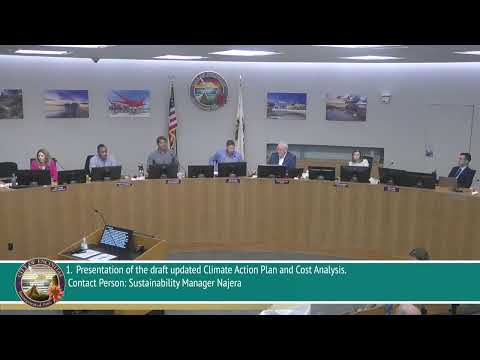
Public splits at Encinitas CAP meeting: commissioners and residents urge adoption; critics challenge costs and modeling
Summary
Fourteen public speakers addressed the Encinitas CAP update: several environmental commissioners and residents urged adoption and highlighted co-benefits and the cost of inaction; others questioned the BCA's narrow scope, the underlying science and potential affordability impacts, prompting council to request further analysis of co-benefits and funding assumptions.
Public comment at Encinitas’s special meeting showed a clear division on the draft Climate Action Plan and its benefit-cost analysis.
"This analysis was by design very limited in scope to only consider the financial costs and benefits of various greenhouse gas reduction measures," said Katie Kramer, an environmental commissioner who served on the CAP subcommittee, urging the council not to interpret the BCA as a reason to drop important measures. "It does not include the vast social and environmental costs of greenhouse-gas emissions."
Multiple supporters—environmental commissioners, scientists and longtime volunteers—commended the staff and EPIC for extensive public engagement and rigorous modeling, and encouraged council to adopt the CAP and use the BCA to prioritize implementation rather than to cut measures. "All of these measures are valid and all necessary to hit our goals," said JP Bruner, a subcommittee member.
Opponents questioned both the premise and the price tag. Dennis Lier cited research he said shows parts of the Earth are greening and asked why the city would spend millions to reduce carbon dioxide, saying: "I don't understand spending anywhere from 12 to 20 million to eliminate carbon dioxide that is greening the Earth." Other speakers raised concerns that mandating certain measures could increase housing costs and hurt workers who rely on existing equipment.
Speakers on both sides urged the council to consider co-benefits—public health, shade and water savings—that the BCA does not monetize. Several commenters warned that reducing the CAP’s value to a dollar-per-ton figure risks obscuring nonquantified benefits.
Councilors heard the comments and asked staff to return with supplemental material that explicitly lists co-benefits for each measure, clarifies which costs are assumed to be grant-funded versus borne by the general fund or private participants, and notes where the city is meeting a state minimum requirement versus voluntarily exceeding it. The council also asked staff to re-run or present sensitivity scenarios for key grant and subsidy assumptions.
No votes were cast on the draft CAP; public comment and the council’s request for deeper, measure-level analysis will inform the follow-up workshop staff plans to schedule in August.