Get Full Government Meeting Transcripts, Videos, & Alerts Forever!
Get email alerts on the Water Utility Oversight topic
No spam. Unsubscribe anytime.
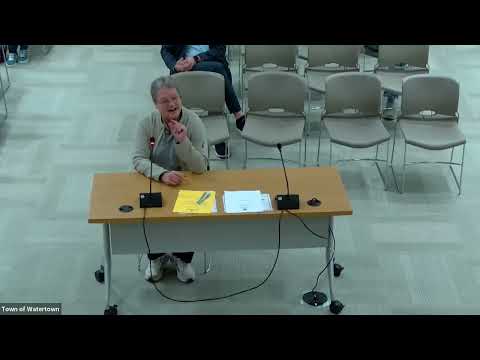
Watertown holds interviews for Water and Sewer review committee after costly Waterberry judgment
Summary
Watertown leaders interviewed multiple applicants for a committee charged with reviewing the Waterberry water and sewer litigation and recommending safeguards; candidates emphasized fact‑finding, transparency, technical expertise and stronger procedures to avoid another multimillion‑dollar liability.
Watertown held interviews for its Water and Sewer Bipartisan Committee as it assembles a review panel to examine the town’s long-running dispute with Waterberry and recommend steps to prevent a repeat of the costly judgment.
Michelle McHugh, chair of the Water and Sewer Bipartisan Committee, opened the session and explained the process: applicants would be asked four questions in the order their applications were received, each would have about five minutes, half of the interviews would be held the first night and the remainder the next evening, and the committee planned to make its selection after both days of interviews.
Applicants described a mix of technical and financial experience. Michael Veles said he would “base all decisions on the facts, being transparent about where you’re going,” and described about 20 years of management and human resources experience; he identified himself as head of human resources for Northeast Transportation, Waterberry Division, and said he lives and works in Watertown and could adjust work hours to attend meetings. Veles summarized the dispute as arising from a rate change and infrastructure allocation, and characterized the town’s exposure at roughly $30.6 million tied to interest and penalties.
Several other candidates emphasized fact‑finding and process. Liz Coswell, a retired IT professional, said the committee should “discover what you knew then and what happened and what transpired,” and asked for clarity about expected time commitments; she said she understood a 30‑to‑40‑hour estimate but was told meetings would likely be one to two hours. David Gerardano, a Class‑2 public water system operator, cited two decades of operational experience and raised concern that unmetered water might have contributed to losses, arguing that meters are central to understanding water use. Jeffrey Cheney, a certified public accountant with 30 years of experience, said he would rely on evidence-based review of financial records and policy development.
Technical expertise was represented as well: Adam Simson, a civil engineer in water and wastewater consulting, said he spends his career on rate work, contract negotiations and utility finance and argued for procedures that provide elected officials stronger information and transparency when making decisions. Several applicants noted the committee may need to interview people involved in past decisions and said interviews and document reviews should be done carefully to maintain decorum while establishing facts.
Candidates raised logistical questions the committee has yet to resolve. Multiple applicants confirmed availability for evening meetings through February 2026; some participants asked whether the new committee would have a budget to hire outside counsel if needed, and the chair said no budget had been set and those decisions would be up to the committee. The chair also asked whether candidates who missed the first night could be scheduled for the second night if they contacted staff.
The session concluded with a motion to adjourn; the motion and second are recorded but the final vote sequence is not fully captured in the provided transcript. The committee’s next step is to finish interviews the following night and then deliberate on appointments.
Why it matters: Watertown formed the review committee after litigation with Waterberry over wholesale water and sewer terms resulted in a substantial judgment and ongoing questions about how past decisions were made. Candidates uniformly urged clearer procedures, stronger documentation and technical review to reduce the risk of future financial exposure.