Get Full Government Meeting Transcripts, Videos, & Alerts Forever!
Get email alerts on the Power Forward topic
No spam. Unsubscribe anytime.
Commonwealth, utilities detail Power Forward funding to pay for utility engineering studies to speed housing development
Summary
State and utility representatives on a webinar described the Power Forward program, which will fund utility engineering studies (one per municipality per year) to help towns evaluate up to three candidate sites for housing. Funding is first-come, first-served with caps and a 90‑day window for developer work after study completion.
A state presenter said the Power Forward initiative will cover the cost of electric-distribution engineering studies to help municipalities assess candidate sites for housing, with the Commonwealth able to cover up to $100,000 per municipality per year (up to $200,000 over two years). The presenter said the overall program cap is $1.5 million this year and $1.5 million next year, and that funding is awarded on a first-come, first-served basis.
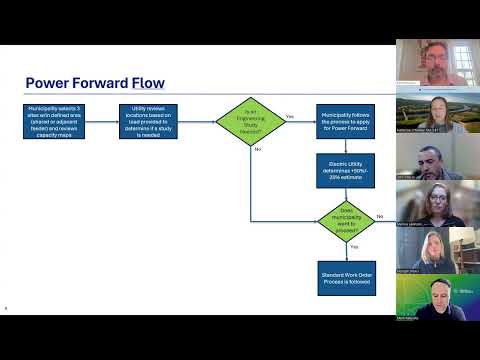
John Dailyaly, director of the New Services Department at Eversource, outlined how the process will work for both Eversource and National Grid: municipalities may select up to three sites within a defined area, consult the utilities' capacity maps to check available capacity, then submit site details and estimated peak load through the utilities' Power Forward application. "The municipality can select up to three sites," Dailyaly said, and utilities will conduct a quick analysis to determine whether a full engineering study is required. If a study is required and a municipality qualifies for funding, the utility will produce a roughly +50%/−25% cost estimate for the study.
Dailyaly said there are three practical outcomes after a study: the municipality can decide not to proceed and only pay for the study; it can proceed and enter the normal work-order process; or it can downsize its load request (for example from 2 megawatts to a smaller request) to avoid a study and pursue a standard new load application.
Morgan Stacy of National Grid cautioned that once a funded study is completed, the utility expects formal work requests and plans to be submitted within a 90‑day window so the company can manage its queue. "There is a 90‑day window following the completion of the study that we'll want to start getting formal work requests submitted and plans moving forward for the development," Stacy said, noting the requirement helps the utility maintain an active queue-management process.
Melissa Levenson, who identified herself as heading the Office of Energy Transformation, highlighted an intended benefit of the program: municipalities can have up to three adjacent parcels evaluated concurrently under a single engineering study, which can reduce costs and speed decisions even in places that are not eligible for the funding. "The big benefit is you can look to up to three different locations concurrently… and get one engineering study," Levenson said.
Panelists advised municipalities to gather estimated peak-load figures from developers, consultants, or their internal staff when completing the application forms; utilities can provide available-circuit capacity from capacity maps and offer rules-of-thumb (panelists cited roughly 2–3 kW peak per housing unit as an average) to help right-size requests. The presenters stressed coordination with account executives at each utility and that municipalities should consider bundling sites to get the most value under the one-study-per-year rule.
The panel confirmed that municipal light plants are not eligible for Power Forward funding and that all municipalities in Eversource and National Grid territories may apply. The panel said they will post slides and a recording of the webinar to the Connecting New Buildings to the Electric Grid page on mass.gov and will share direct links in the chat. Applicants should submit Power Forward applications through their utility's website; earlier applications will have an advantage because funds are capped and allocated on a first-come, first-served basis.
The webinar concluded with panelists encouraging municipalities to reach out to utility account executives or use the posted links for next steps. No formal votes or motions were taken.