Get Full Government Meeting Transcripts, Videos, & Alerts Forever!
Get email alerts on the Racial Equity topic
No spam. Unsubscribe anytime.
State board reviews progress on 2023–2025 racial equity action plan, highlights data tools and tribal engagement
Summary
Board staff presented the 2025 annual update on the three-year racial equity action plan: 38 of 53 actions are marked complete, staff rolled out an equity data handbook and tribal mapping tools, and presenters urged resources for workforce equity and sustained community engagement; public commenters urged stronger Safer program alignment and more implementation resources.
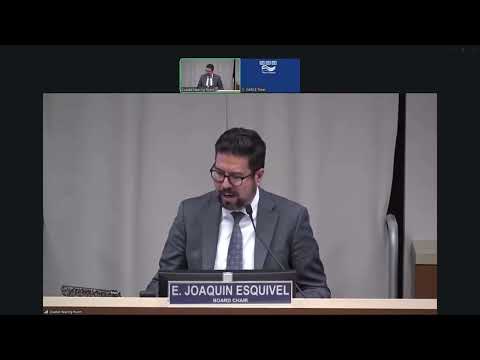
The State Water Resources Control Board received its 2025 annual update on implementation of the 2023'025 racial equity action plan on May 19, hearing progress reports from divisions and offices and public recommendations for the next phase.
"The purpose today is to highlight the progress on the actions within the state water board's racial equity action plan that were prioritized from 2023 through 2025," Amy Kronson, assistant director for the Office of Public Engagement, Equity, and Tribal Affairs, said as she introduced the item and the year's accomplishments.
Presentations described crosscutting efforts: Anna Holder (Office of Information Management and Analysis) highlighted an "equity data handbook" intended as a living resource to help staff apply an equity lens in data-intensive work and reported 24 rollout presentations; divisional speakers described adding demographic data to integrated reports, prioritizing grants (319(h)) for disadvantaged communities, completing a wastewater needs assessment (UCLA contract) to identify priority facilities, expanded tribal engagement and a tribal consultation dashboard, and a tribally centered harmful algal bloom (FHAB) training series.
Board members and staff emphasized the challenge of sustaining work amid constrained resources. Veronica Farwell and others described workforce equity and inclusion efforts and the need to embed equity tools into routine decision-making. Board Member Nicole Morgan described how staff's lived experience informs the work and thanked teams for integrating equity into technical programs.
Public commenters urged further alignment between the Safer program and the racial equity action plan. Kaia Rivers urged that Safer treat community engagement and technical assistance as core program outcomes rather than conditional activities, and Eric Oriana of Leadership Council for Justice and Accountability urged use of consolidation orders where appropriate to secure long-term drinking water solutions for residents.
Staff outlined next steps and announced the process for REAP 2.0, with phased public workshops planned for summer 2026 and anticipated adoption in early 2027. The update and related materials are posted on the board's racial equity web page.