Get Full Government Meeting Transcripts, Videos, & Alerts Forever!
Get email alerts on the Six Year Program Public Comments topic
No spam. Unsubscribe anytime.
NVTA staff report public-comment results on proposed six‑year program; recommendations due June 17
Summary
NVTA staff told the Planning Coordination Advisory Committee that 27 project applications requested $1.265 billion for the proposed six‑year program (FY26–31) and that public engagement produced 265 unique commenters and about 700 comments. Staff will present funding recommendations on June 17 after the Authority finalizes the funding envelope.
The Planning Coordination Advisory Committee of the Northern Virginia Transportation Authority met May 27 and heard staff present the results of the public comment period for the Authority’s proposed six‑year program for fiscal years 2026–2031.
Dr. Nam, an NVTA staff presenter, told the committee that the call for projects produced 27 applications requesting $1.265 billion and that the public engagement window ran from April 2 through May 17. "We received 27 applications for a total request of 1.265 billion," Dr. Nam said, and summarized that "245 people commented. 20 people came in person and some of them remotely ... another five comments received through mail," noting duplicates were removed to yield 265 unique commenters and about 700 total comments.
Why it matters: NVTA staff must balance statutory performance measures — including the required congestion‑reduction‑relative‑to‑cost (CRRC) metric — with qualitative inputs from residents and stakeholders when making funding recommendations. The committee heard that the Finance Committee recommended a projected revenue amount (PGO) of roughly $775.58–775.88 million to use as the funding envelope for this cycle; staff said the Authority’s approval of that figure is required to finalize recommendations.
Staff described the materials made available online during the engagement period: full evaluation results, a map of project locations and two‑page summaries of each application. Dr. Nam said staff also used social media, direct outreach through jurisdiction public information officers and an in‑person public hearing on May 14, and that zip‑code data were collected to help locate commenters. "We published all the information ... on our website," Dr. Nam said, and staff reported targeted outreach at events such as Arlington’s bike‑to‑work day.
Committee members pressed staff on how public comments are weighed. Vice Mayor Hedrickk asked whether the process counts raw comment totals or the ratio of support to opposition, and whether targeted outreach was used in project areas. In response, staff said there is no single numeric weight assigned to public comments; instead, public comment is treated as a qualitative input that staff reviews alongside the quantitative CRRC and other statutory measures. "We don't want to give the appearance that you provided comments and you just provided comments," a staff member said, adding that staff screens for mass or identical "blast" submissions and reviews content and zip‑code relevance.
Committee members asked for a more descriptive, thematic summary of comments rather than only counts. Board Member Spain said a qualitative synopsis of themes and specific objections or suggestions would help members when they later vote. Staff agreed and said it will provide the full comment set and a themes/qualitative summary in the forthcoming report.
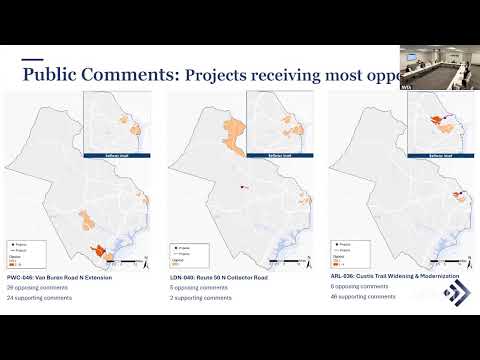
Staff also highlighted where comments clustered by project and geography: two projects on the slides drew the most comments (one received 70 supportive comments and another 52), and an Arlington trail project received 46 supportive and six opposing comments. Other projects, including a Prince William road project and a Loudoun Route 50 collector, showed roughly even support and opposition; staff noted some opposition comments originated from areas distant from the project site.
On next steps, staff said they will prepare funding recommendations that reflect the technical rankings, statutory priorities (including CRRC), qualitative factors and public comments, and present those recommendations to the committee at its June 17 meeting. The Authority is expected to consider the program in July after the Planning and Programming Committee and Authority review; staff said the Finance Committee’s PGO recommendation will be considered at the Authority’s June meeting.
The meeting record shows only the approval of the March 25 meeting notes as a formal action at this session; no funding decisions were made. The committee adjourned after brief administrative announcements.