Get Full Government Meeting Transcripts, Videos, & Alerts Forever!
Get email alerts on the Maintenance And Enrollment topic
No spam. Unsubscribe anytime.
Select Committee probes maintenance formulas as enrollment drops; virtual ADM, right‑sizing and insurance emerge as top concerns
Summary
LSO and the State Construction Department briefed the committee on major vs routine maintenance formulas, highlighting that many districts have more actual square footage than the formulas authorize; members and public commenters pressed on virtual ADM, the 115% vs 135% multiplier, educational suitability for repurposing space, and growing insurance pressures for roofs and other systems.
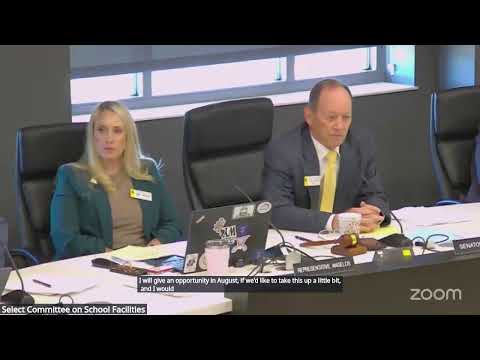
On May 19 the Select Committee on School Facilities spent the bulk of its meeting on a technical but consequential subject: how Wyoming calculates and funds routine and major maintenance for school buildings — and whether those formulas remain appropriate as enrollment declines.
Katherine Camarota, LSO budget and fiscal staff, canvassed the "two streams" approach: a major maintenance formula that multiplies authorized gross square footage by per‑square‑foot replacement value and a 2.5% condition factor to estimate annual major maintenance payments, and a routine maintenance stream funded through the education resource block grant model that allocates custodians, maintenance FTEs and supplies at the building level. "Authorized square footage is impacted by three factors," Camarota told the committee, listing actual building square footage, prior year's average daily membership (ADM) and the allowable square‑footage multiplier.
The presentation prompted sustained questioning about declining enrollment and virtual education. Senator Rothfuss and others asked whether including full‑time virtual students in ADM gave some districts a funding advantage for allowable square footage. "They are being allocated more square footage than they would otherwise if those students were excluded," LSO and State Construction Department staff acknowledged, noting that capacity analyses used in construction decisions typically exclude virtual students and that any change to funding practice would likely require statute.
Public testimony underscored the policy stakes. Adam Ortman (Weston 1) and Troy Decker (Sheridan County SD2) described districts with large unfunded square footage and costly component‑level needs — roofs and HVAC systems that can cost millions — and warned that smaller ADM does not eliminate the cost of maintaining roofs, exterior systems and site infrastructure. "A roof will not be impacted by the number of students," Decker said. The committee heard similar examples from Campbell County, which used a one‑time funding increase to modernize district access control.
Insurance and infrastructure risks entered the discussion. Andy Knapp (Laramie County SD1) reported rising property insurance deductibles and premiums and cited local water‑system pressure problems that may force districts to build pump houses or redesign fire‑protection systems. Brian Farmer (Wyoming School Boards Association) briefed the committee on the School Risk Retention Program (SERP), a 32‑district pool that buys reinsurance and must weigh regional wind/hail risk and rising replacement costs when setting premiums.
What the committee asked staff to do: members directed LSO and the State Construction Department to prepare more detailed district‑level analyses — showing authorized vs actual square footage, ADM trends, and projected major maintenance need — and to return at a subsequent meeting with options for (a) whether to adjust the 115% allowable multiplier used in normal years or (b) make a more targeted statutory or programmatic change to address educational suitability and reprogramming needs without diluting critical maintenance dollars. The department also said it will pilot routine‑maintenance training and host a Q&A resource for facility managers.
Why it matters: the formulas determine how limited state dollars flow to district buildings. As enrollment declines and districts grapple with aging roofs, HVAC systems and extraordinary insurance costs, the committee’s interim work may shape whether districts keep more control of building decisions or the state pursues statutory changes to square‑footage and eligibility rules.