Get Full Government Meeting Transcripts, Videos, & Alerts Forever!
Get email alerts on the Evv topic
No spam. Unsubscribe anytime.
Training video explains EVV procedures for Medicaid attendants
Summary
A narrated training video demonstrates Electronic Visit Verification (EVV) procedures for Medicaid attendants, covering clock-in/out, plan-of-care limits, error correction, HIPAA privacy, and employer-of-record responsibilities.
Maya, an attendant and the narrator, walks viewers through a full shift using an Electronic Visit Verification (EVV) app, saying she uses it to confirm she arrived at the right time, location and provided the approved service. She warns that "No EVV means no proof of service, and no proof of service means no payment," and that EVV is required under the 21st Century Cures Act. Maya describes routine steps: selecting the correct member and service in the app, clocking in and out, and documenting time and location automatically.
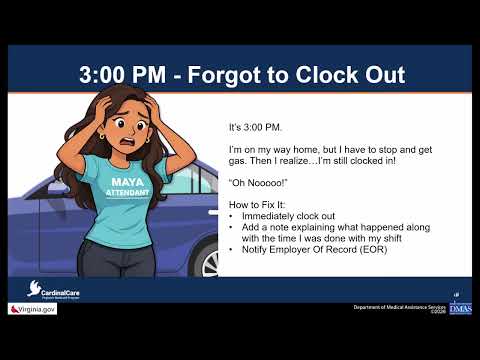
Maya and Richard, identified in the video as her employer of record (EOR), emphasize following the member's plan of care and not performing tasks that are not authorized. Maya notes rules that affect attendants: a 16-hour limit in any 24-hour period and a requirement to finalize shifts within 30 days or risk nonpayment. She explains how to correct errors: clock out immediately, add a note explaining the correction, and notify the EOR. The video lists four exceptions that may justify a non-compliant shift: living with the member, new enrollment eligibility, a member emergency, or the shift being fully non-compliant.
The video also covers privacy: Maya cautions against discussing care in public, sharing login credentials, or posting about members online, saying the EVV app contains protected health information and should be treated "like a locked medical chart." The Department of Medical Assistance Services (DMAS) is shown as a contact resource with an email for questions (cdattendantinfo@dmas.virginia.gov). The narrator closes by urging attendants to follow the plan of care, clock in and out in real time, correct errors promptly, and protect member privacy.