Get Full Government Meeting Transcripts, Videos, & Alerts Forever!
Get email alerts on the Ambulance District topic
No spam. Unsubscribe anytime.
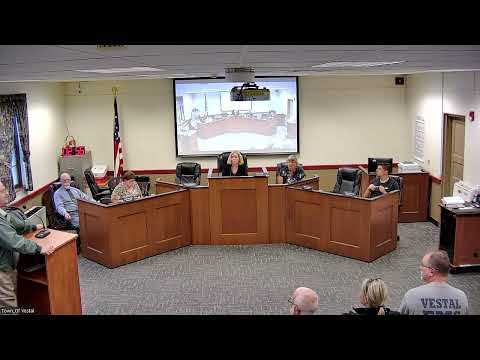
Vestal board approves townwide ambulance district, overrides tax cap to fund EMS
Summary
After a public hearing with dozens of residents, the Vestal Town Board voted Aug. 21 to establish a townwide ambulance district under Town Law Article 12‑a and adopted a local law to override the tax‑levy limit to fund emergency medical services. The move draws an estimated $0.42 per $1,000 of assessed value this year; residents asked why funding is based on property assessments rather than service use.
The Vestal Town Board voted Aug. 21 to create a townwide ambulance district and to adopt a local law to override the town’s tax‑levy limit so that the ambulance service can be funded outside the existing cap.
At a public hearing at Vestal Town Hall, board officials said Vestal EMS — largely volunteer but with some paid paramedics — has run at minimal cost and is now facing unsustainable deficits. The board introduced EMS representatives Jerry Schultz and Mark Tomco and said the district would raise about $0.42 per $1,000 of assessed value this year, roughly $42 on a $100,000 home, based on current assessments.
“The town is transitioning: the fire department is becoming independent and, at the same time, we have had the issue of EMS needing our help,” a board speaker said while opening the hearing. “At some point you have to decide whether you want an ambulance service or not.”
Why a property tax? Several residents objected that a tax based on assessed value is not directly tied to service use. “Why are we paying for it based on the value of our homes?” Tom Mooney of Rockwell Road asked. “Why aren’t the people who use the services… paying for it?” Mooney suggested a flat fee or user‑pay model instead of varying rates tied to property value.
An EMS representative answered questions about finances and equipment replacement schedules, saying the service has tried to be frugal, uses bank loans or vendor financing for large purchases and aims to rotate ambulances on a multiyear schedule. The speaker said pandemic relief temporarily bolstered cash flow but the fund balance has since dwindled; planned ambulance replacements and aging stretchers are driving capital needs.
Resident Charles Kolinsky of Murray Hill Road asked whether ambulance and equipment purchases were financed by bonds or amortized loans and how the stated roughly $600,000 shortfall was calculated. An EMS representative said capital costs are typically financed or amortized and that bookkeeping is done with assistance from a local CPA and an accounting firm.
Other residents raised practical questions: Holly Grus asked whether EMS would cover university students and retail visitors; the board said the taxing district would apply to all assessed properties within the town, commercial and institutional properties included unless tax‑exempt. Another resident suggested a countywide consolidation of ambulance services to spread costs; a board member said that would be a separate Broome County conversation.
Board and budget mechanics: officials explained the town’s total 2024 levy is about $12 million; removing the fire district’s roughly $2 million levy and adding an estimated $1 million for EMS shifts where levies appear but does not necessarily lower a resident’s overall combined tax burden. The board said EMS budgets will be reviewed annually and that potential future levy requests would be subject to budget scrutiny; the town also noted the interaction with the 2% tax‑cap rules when district boundaries and levies change.
Despite concerns about tax fairness and future rate changes, the board voted — initially and then again after a procedural revote to follow attorney guidance — to (1) adopt a local law to override the tax‑levy limit established in General Municipal Law 3‑c (agenda item 4.1.1), (2) approve a resolution authorizing establishment of a townwide ambulance district under Town Law Article 12‑a (agenda item 7.1.1), and (3) authorize advertising the notice of adoption subject to a permissive referendum (agenda item 16.11). The board conducted voice votes; the transcript shows the measures carried, but no roll‑call tallies were recorded in the meeting record.
What residents heard in dollar terms: the board repeatedly used concrete examples to frame costs. At $0.42 per $1,000 of assessed value, a $100,000 home pays about $42 a year; if the rate were to triple, the annual cost to that homeowner would be roughly $120. Officials said the exact rate in future years will depend on EMS budget requests, revenues from insurance billing and any other funding sources the service secures.
Next steps: the board authorized public notice of adoption and indicated the action will be subject to a permissive referendum; the town will advertise the adoption notice on Aug. 26, 2024. EMS will submit an annual budget to the town for review, and the district will operate as a separate taxing district while the volunteer fire department completes its transition to independence under state law.
Authorities referenced in the hearing included General Municipal Law 3‑c (tax levy cap) and Town Law Article 12‑a (establishment of ambulance districts). The board said its town attorney coordinated language and deadlines to ensure the correct procedures for the votes and notices.
The meeting record shows wide public support for continuing ambulance coverage, paired with questions about fairness and funding design. The board completed a revote to correct procedural order, carried the measures, and adjourned after final votes.