Get Full Government Meeting Transcripts, Videos, & Alerts Forever!
Get email alerts on the Retirement Plan Reporting topic
No spam. Unsubscribe anytime.
Committee backs Form 5500 filing-simplification bill amid concerns about data timeliness
Summary
The committee approved HR7362 to establish a single statutory deadline for Form 5500 filings aimed at reducing duplicative extension filings; ranking member warned the plan could further delay public availability of pension data and questioned whether automatic extension rules would change.
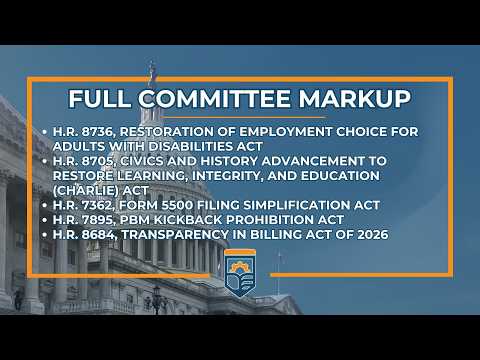
The House committee approved HR7362, the Form 5500 Filing Simplification Act, and ordered it reported to the House (committee vote 22–12). Sponsor Representative Growthman described the measure as a bipartisan effort to modernize and simplify ERISA reporting by setting a single uniform filing deadline for annual Form 5500 submissions to cut redundant extension steps.
Ranking member Representative Bobby Scott acknowledged the administrative burden the bill seeks to address but raised concerns that setting a new statutory deadline could create uncertainty about whether the existing automatic extension process (Form 5558) would still apply and could worsen the timeliness of publicly available Form 5500 data. "I'm just seeing that no one has said that the total 10‑month period is too short," Scott said, noting the need for timely data so regulators and Congress can act earlier on deteriorating plans.
The sponsor clarified committee intent that the IRS instructions establish the filing deadline and that additional automatic extensions would not be granted beyond the statutory date. The committee adopted the amendment in the nature of a substitute and voted to report the bill to the House, with the chair instructing staff to make technical edits before transmission.
Next steps: HR7362 will be transmitted to the House; stakeholders including researchers who rely on Form 5500 data have signaled interest in the bill's effect on public-data latency.