Get Full Government Meeting Transcripts, Videos, & Alerts Forever!
Get email alerts on the Employment Disability 14c topic
No spam. Unsubscribe anytime.
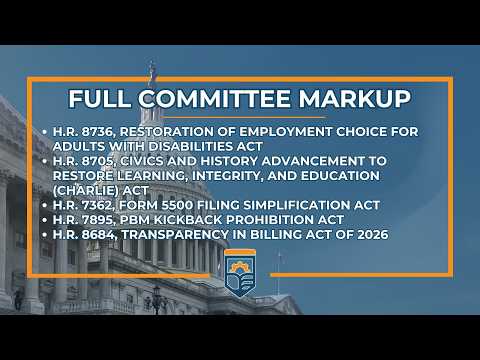
Committee advances bill to restore 14(c) work options for adults with disabilities after heated debate
Summary
The House Education and Workforce Committee approved HR8736, which eases federal safeguards on subminimum-wage 14(c) employment and was reported to the House by an 18–15 vote after sustained floor debate over worker protections and dignity of work.
The House Committee on Education and the Workforce voted to report HR8736, the "Restoration of Employment Choice for Adults with Disabilities Act," to the House with an amendment after a contentious markup and a final committee vote of 18–15.
Representative Glenn Gothman, the bill's sponsor, told the committee the legislation restores choice for people with disabilities by rolling back post-2014 requirements that, in his view, forced job seekers to "try and fail" at multiple community positions before accessing sheltered-workshop employment under Section 14(c). "14C is about choice," Gothman said while explaining the amendment in the nature of a substitute.
Opponents, led by the committee's ranking member, raised statutory and human-rights concerns. Representative Bobby Scott argued the 2014 Workforce Innovation and Opportunity Act protections—commonly grouped under Section 511—were intended to promote competitive integrated employment and protect younger workers from being steered into subminimum wages without adequate transition services. Representative Lucy McBath recounted investigative reporting she entered into the record describing long-term abuse of subminimum-wage employees and noted Government Accountability Office figures showing the average 14(c) wage around $3.50, saying, "They were abused and treated like children." McBath urged colleagues to preserve safeguards and to support a phased transition backed by grants and technical assistance.
Supporters pushed back that many families and workers value sheltered-workshop settings for socialization, meaningful routines and the "dignity of work," and that in some districts workers displaced by closures did not find comparable full‑time community jobs. Several members urged colleagues to tour local 14(c) facilities before voting to eliminate options.
The committee considered several amendments, including a proposal (McBath AMD_MPTA) to create a technical assistance center and fund a phased transition to competitive integrated employment; that amendment was defeated in an earlier tally (15–18) and the floor postponed some roll-call votes. Ultimately the committee adopted an amendment in the nature of a substitute and moved the bill forward. The sponsor and opponents both said they intend to continue debating implementation and safeguards as the measure proceeds to the House.
The committee action was procedural: the chair moved that HR8736 be reported with the committee's recommendation, and the motion passed by recorded vote. The committee clerk and staff were authorized to make technical and conforming changes before transmittal.
What happens next: HR8736, as amended, will be transmitted to the House of Representatives for further consideration on the floor; supporters said they hope to preserve worker choice, while opponents signaled plans to press for transition funding and other protections in subsequent consideration.