Get Full Government Meeting Transcripts, Videos, & Alerts Forever!
Get email alerts on the Short Term Rentals topic
No spam. Unsubscribe anytime.
Raymond planning board’s draft short-term rental ordinance moves toward public hearing amid split views
Summary
Planning-board chair Rob Hill presented a draft short-term rental ordinance that would require registration, annual safety inspections, occupancy limits tied to septic capacity and a three-strike enforcement rule; the select board agreed to advance the draft to a public hearing after questions about enforcement, insurance and data collection.
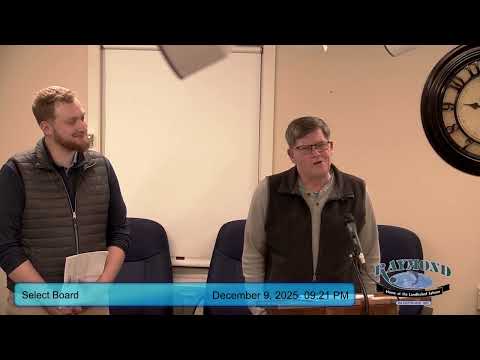
Rob Hill, chair of Raymond’s planning board, told the select board the draft short-term rental ordinance responds to petitions and public workshops and is intended to be a “workable document” that addresses safety, occupancy and registration.
The planning-board chair said the board reviewed a citizen-drafted ordinance that had gathered about 278 signatures and moved it into a legally vetted format. “The ordinance that you have before you now addresses key components: we looked at safety, occupancy, egress and limits on occupancy,” Rob Hill said. He told the board the draft would require property owners to obtain a license and that fees would be scaled to offset inspection and administration costs but “can’t be a money maker for the town.”
Why it matters: The ordinance would create the town’s first systematic record of short-term rentals through registration and inspections, which planners said is intended to produce data on how many properties operate as short-term rentals and whether that activity changes neighborhood character.
The draft would tie overnight occupancy to septic capacity and bedrooms (a standard of two adults per bedroom, with limited daytime exceptions) and would require fire-and-life-safety inspections before licensing. It also proposes a three-strike enforcement approach that could revoke a license for repeat problems and does not include waivers. The planning board removed a separate appeals-to-staff provision and expects any appeals to follow the zoning board of appeals process, Brett, the town’s contract planner, said.
During the discussion, residents and board members pressed for clarity on enforcement tools, insurance requirements and practical limits. Derek warned about neighbor-versus-neighbor complaints and asked who would judge whether disturbances were “relevant.” A planning-board member said section 4 includes performance standards—such as occupancy thresholds—that staff could apply objectively.
Several residents urged a more gradual approach. Mark, who identified himself as a local short-term rental owner, said the draft could substantially reduce occupancy on newer, large homes and warned it might depress property values; he also said a legal fund had been raised to challenge restrictive measures. “We have half a million dollars in a legal fund ready to sue the town,” Mark said. Opposing commenters urged moving the ordinance forward so the town can collect data through registration.
Board next steps and process: The select board did not adopt the ordinance tonight; members directed staff and the town manager to review the draft, then hold a public hearing and finalize any amendments. Chris, a board member, said the draft is a “good start” and recommended tweaks after the public hearing. The manager recommended that the town manager and the code officers review implementation details before the hearing.
What’s unresolved: Several questions remain open, including whether the insurance language is enforceable as written, the precise renewal/appeal timelines for noncompliant properties, and whether platforms or third-party scrapers should be used to help enforcement and registration matching. The planning board and staff said more data from registration is a core justification for the approach.
The board scheduled moving the draft forward to the public-hearing process; final ordinance language and any vote would follow that hearing and subsequent deliberations.