Get Full Government Meeting Transcripts, Videos, & Alerts Forever!
Get email alerts on the Natural Resources topic
No spam. Unsubscribe anytime.
Deer-management survey shows early ecological gains but researchers question methods
Summary
A year-1 vegetation survey tied to Irvington's deer-management program reported decreases in browsed seedlings and increases in reproductive plants, but meeting researchers and trustees warned that volunteer data collection and the absence of statistical tests limit how 'significant' the findings can be considered.
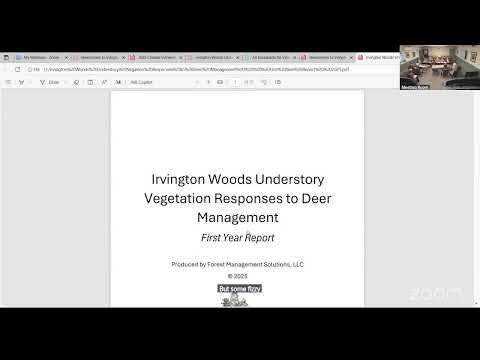
Presenters summarized the 2025 vegetation survey conducted as part of Irvington's deer-management initiative and reported small but encouraging trends in the forest understory. "The proportion of browsed seedlings decreased from 68% down to 38%," a presenter reported, noting also modest increases in seedling height and reproductive wildflower counts.
Presenters cautioned that the past summer's drought likely affected seedling counts and that the modest changes observed are not a dramatic shift. The survey was performed with community volunteers and summer interns; the committee reported that Dr. Danielle Begley Miller performed the previous-year baseline survey and provided training and analysis guidance.
A meeting participant who identified their concern from a research perspective pushed back on how the report used the term "significant," saying statistical tests (regressions or p values) had not been shown and that directional changes could be noise, intervening variables (for example, drought) or measurement inconsistency. "The word significant is a term of art and there is no significant finding there unless there is a statistical test run," the participant said.
Trustees acknowledged the trade-off between paying an expert for full-year data collection and using trained volunteers to reduce costs. David Zel, who said he will join the board soon, noted the board had chosen a volunteer-collection model initially to save money while relying on expert training and analysis; he recommended the board consider hiring the expert for future years if stronger, grant-ready documentation is desired.
Next steps: presenters and trustees agreed to discuss whether to fund expert-led data collection for future surveys, to standardize photo documentation of plots and to refine methodology to strengthen the study's defensibility for grant applications.