Get Full Government Meeting Transcripts, Videos, & Alerts Forever!
Get email alerts on the Budget topic
No spam. Unsubscribe anytime.
Quincy School District budget update: $5.9 million in reserves, staff flag transportation funding limits
Summary
Tia, presenting the district budget, told the board the district began the year with $5.9 million in reserves, has received about 70% of budgeted revenues and spent roughly 67% (95% when encumbrances are included). Board members pressed staff on transportation funding and the state's efficiency rating for rural districts.
Tia, presenting the Quincy School District general fund as of April 30, said the district began the year with $5.9 million in reserves and had received about 70% of its budgeted revenues while spending roughly 67% of budgeted expenditures.
The presenter said encumbrances — purchase commitments and payroll obligations — bring the effective commitment level to about 95% for the year, and described recent changes to how supplemental stipends are paid to smooth monthly payroll. "We started the year with $5.9 million in reserves," Tia said. "So far we've received 70% of our budgeted revenues, which is right here. And then we've spent 67% of our budgeted expenditures. And then if we add in what we encumbered ... we're at 95%."
Why it matters: the board heard a picture of relative fiscal stability after a year of federal-funding uncertainty, and staff described new procedural controls intended to reduce end-of-year payroll spikes.
Key revenue and spending details presented Tia summarized revenue sources year-to-date as roughly 74% state apportionment, 19% local (primarily levy) and 7% federal funds (Title programs, migrant programs). She told the board Title allocations have fallen over the last five years even though enrollment has not tracked down on the same scale, a pattern she attributed to changes in census-driven allocation formulas.
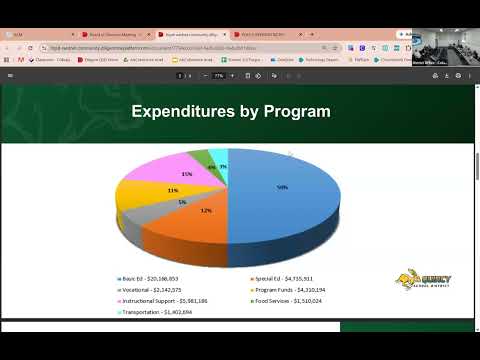
On program spending, Tia said about half of expenditures are in basic education, while instructional support, transportation, special education, program funds (Title, migrant, other grants) and food services occupy the remaining budget in the proportions shown in the district report.
Transportation funding and rural-district limits Board members asked whether transportation would remain within budget given higher fuel costs. Staff explained the state's transportation-efficiency rating and routing expectations, noting this efficiency model can disadvantage very large rural districts. "It's really more designed for your I‑5 corridor schools," a staff member said, describing how the routing efficiency calculation can force very early pickup times to maintain the measured efficiency that influences funding.
Tia and staff cautioned that while the district's efficiency scores have historically been high — and that can secure funding at prior-year expenditure levels — the model "comes at a cost" in practice for long‑distance rural routes.
Federal funding and staffing posture After a year of uncertainty over federal funds, the district said it now uses a conservative approach to FTE budgeting and reviews vacant positions before filling them. Tia said the district has pursued process efficiencies in HR and onboarding and highlighted recent clean state audits and a stable Moody's rating.
Board action Earlier in the meeting the board approved the consent agenda by voice vote after discussion. The budget presentation itself was an informational report; no budget adoption vote occurred at this meeting.
What happens next Staff will return with additional materials as needed, and the board received direction to review climate‑survey materials and other reports at the June 9 meeting.