Get Full Government Meeting Transcripts, Videos, & Alerts Forever!
Get email alerts on the Overlay Districts topic
No spam. Unsubscribe anytime.
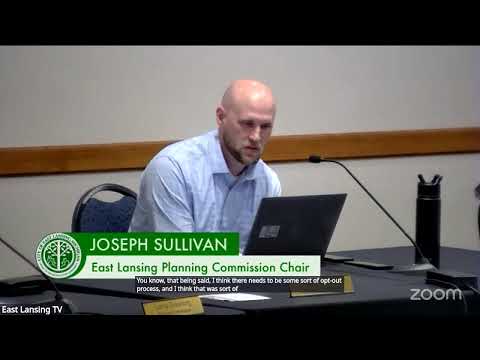
Planning Commission urges council not to adopt narrow ordinance to remove properties from rental overlays
Summary
After extensive public comment from neighborhood leaders and residents, the commission voted May 27 to recommend that City Council not adopt Ordinance 1572, a narrowly written process that would let certain owner‑occupied parcels petition to leave rental‑restriction overlay districts.
The East Lansing Planning Commission on May 27 recommended that City Council not adopt Ordinance 1572, a narrowly drawn proposal that would create a special procedure for some owner‑occupied properties to petition for removal from residential rental‑restriction overlays.
Ordinance 1572, as introduced by council staff, would permit removal only if three tests are met: the parcel lies on a side of a city block where the other homes on that same block face are not subject to the overlay; the property is owner‑occupied and not currently rented; and no more than two owner‑occupied non‑rented properties (including the applicant) exist on that block face. Planning staff’s analysis estimated the measure might make 10–15 parcels across the city potentially eligible under those narrow criteria.
Why it matters: Overlay districts in East Lansing were established by resident petitions to limit conversion of single‑family houses into high‑occupancy student rentals. Over three dozen neighborhood leaders and residents told the commission the proposed change would undermine those neighborhood protections, reduce the power of community‑led petitions and create an easier path for property owners to exit an overlay than the community needed to adopt one originally.
Residents and neighborhood associations submitted extensive testimony. Theodore Bena, president of the White Hills Neighborhood Association, told commissioners that overlays ‘‘were not created like ordinances’’ and cautioned against a council‑driven process that would ‘‘usurp’’ the neighborhood petition process. Diane Wing (Chesterfield Hills) recounted repeated quality‑of‑life problems near nearby student rentals — loud parties, illegal urination and an instance she described where occupants burned furniture in a backyard — and urged commissioners to oppose the amendment. Jeffrey Hank and several property owners spoke in favor, saying the ordinance would address legal defects in the overlay program and allow limited relief for property owners facing unintended consequences of the overlays.
The commission’s concern: Commission members and neighborhood speakers said that if a new process to remove properties is created, it should be at least as difficult as the process to create an overlay (which often required a large petition and substantial neighborhood effort) and should preserve neighborhood consent mechanisms. Several commissioners said the remedy, if any, should be a broader, deliberative effort that treats expansion and contraction of overlays with the same community‑level voting thresholds used when overlays were formed.
Next steps: The commission’s recommendation — that council not adopt Ordinance 1572 as introduced — will be transmitted to City Council for the council’s public hearing, expected July 21. Commissioners urged council to consider alternative approaches and to preserve the unit of decision as the neighborhood rather than a single parcel.