Get Full Government Meeting Transcripts, Videos, & Alerts Forever!
Get email alerts on the Homelessness topic
No spam. Unsubscribe anytime.
Bangor residents press council for immediate action on homelessness as public comment dominates meeting
Summary
More than an hour of public comment at the May 27 Bangor City Council meeting centered on homelessness, drug use, and public‑safety concerns; residents and service providers offered competing remedies ranging from immediate low‑barrier day centers to housing‑first policies.
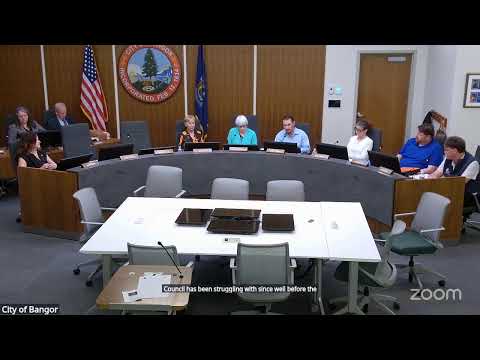
Bangor — A packed public‑comment period at the Bangor City Council’s May 27 meeting became a de facto hearing on homelessness and public safety, as more than two dozen residents and service providers urged action while expressing sharply different views on remedies.
The comments began with Scott Party, who said a proposed low‑barrier service center “is not a conceptual starting point for endless debate. It is an immediate zero‑cost necessity,” arguing the plan would clear sidewalks, reduce needles and human waste in parks, and help contain a local HIV cluster by providing steady access to medical aid and recovery resources. “We do not have the luxury of time to let this stall in committee,” he said.
Other residents described everyday safety concerns. Katie McCarthy, who identified herself as a longtime Bangor resident and a supervisor for the city’s pools, said seasonal staff—many teenagers—regularly train to spot overdoses and administer naloxone after finding needles near pools and playgrounds. “This is a public park, a public pool where kids go on their own,” she said, adding that the conditions affect her plans to live and work in Bangor after graduation.
Voices from the recovery community and service providers stressed different priorities. Grace Nichols of ACT UP Bangor called for an urgent public‑health education response to a reported cluster of HIV cases and urged residents to join a June 5 vigil at City Hall. William Hurley, executive director of Needle Point Sanctuary, said the organization will shift syringe services off Park Street to Ohio Street and end the Park Street pilot on Aug. 31, while praising the pilot’s reach and noting it facilitated hundreds of service encounters and overdose reversals.
Other commenters urged long‑term investments and housing‑first approaches. Zach Campbell, co‑founder and board president of Needle Point Sanctuary, said countries that adopt housing‑first policies reduce emergency costs and improve outcomes; he urged the council to “house people” rather than rely on temporary measures.
Several residents argued for accountability and enforcement, not just services. Colleen O’Neal criticized existing spending on downtown safety and cleanup programs and opposed a plan she described as a perennial “band‑aid,” calling for stronger enforcement of laws and job creation to address root causes.
The contrast between calls for immediate low‑barrier services and demands for stronger enforcement underscored the depth of public concern. Council members responded during later agenda items by advancing initiatives aimed at increasing housing capacity and coordinating services, including the creation of a standing housing committee and appointment of an advisory committee on homelessness.
The meeting closed with council members acknowledging the intensity of the debate and promising more committee work and public outreach. Council members emphasized the complexity of the problem and said multiple approaches would be pursued, including short‑term programs, grant funding, and efforts to increase long‑term housing supply.