Get Full Government Meeting Transcripts, Videos, & Alerts Forever!
Get email alerts on the Nuisance Code topic
No spam. Unsubscribe anytime.
Shelton council asks staff to draft clearer rules on storage of personal property in public spaces
Summary
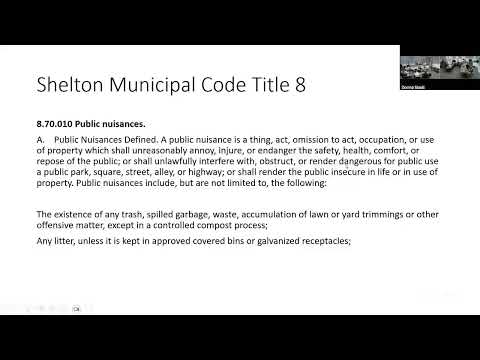
At a May 26 study session, Shelton city staff reviewed nuisance and camping code examples from other cities and discussed adding objective definitions (e.g., 55-gallon/7-cubic-foot thresholds and time limits) to address bulky accumulations in parks, sidewalks and rights-of-way; council directed staff to return with options and attorney review.
Shelton's council on May 26 discussed tightening code language around the storage of personal property in public spaces, directing city staff to research ordinance options and return draft language for attorney review and future public hearings.
City Manager Mark Sigler framed the issue by pointing to constitutional constraints and the limits of current code. He told the council that any local regulation must respect the Fourth and Fifth Amendments and be drafted to reduce subjectivity in enforcement. Sigler said examples from other Washington cities ' including Longview and Redmond ' use concrete definitions to make enforcement more consistent, such as thresholds for bulky items and explicit treatment of camping paraphernalia.
The council discussed several concrete points that would shape any proposed code changes. Staff cited examples used elsewhere: items that do not fit inside a 55-gallon container or exceed roughly 7 cubic feet are often treated as "bulky" and subject to different rules than small, short-term items. The council also heard staff explain operational practices under the city's camping ordinance, including a 60-day hold on personal property collected during abatement and centralized storage with identification of the owner.
Council members stressed they did not want enforcement to be punitive or to "weaponize" code against people with few resources. Concerns included the need for (1) a clear time-based definition of "storage" (how many hours or days constitutes excessive storage), (2) distinctions between short-term recreational use (picnic blankets, chairs) and long-term accumulations, (3) protections for people with disabilities or chronic illnesses, and (4) coordination with housing and social services so enforcement is paired with assistance.
Several council members urged staff to include nonpunitive options and partnerships with local nonprofits. One council member suggested reconvening a housing task force and expanding emergency and transitional housing capacity in parallel with any code changes.
After discussion the council provided direction for staff to: compare model code language from other jurisdictions, identify optional objective thresholds (size/time), assess enforcement processes and recordkeeping, consult the city attorney about constitutional risk, and develop outreach and support options before any ordinance is introduced. Staff said the matter would proceed through the standard ordinance process and public hearing if council chooses to pursue changes.
The council did not take a vote on a specific ordinance during the study session; instead members directed staff to prepare draft options and return with recommended language, implementation steps and any related resource or funding needs.