Get Full Government Meeting Transcripts, Videos, & Alerts Forever!
Get email alerts on the Public Safety Facility topic
No spam. Unsubscribe anytime.
Cohasset forum previews $21.8M town-meeting ask to finish new public-safety facility
Summary
At an April 29 public forum, Cohasset officials outlined a plan to complete a new combined police and public-safety facility and said they will ask Town Meeting on May 9 to approve Article 21, a $21,783,000 borrowing request toward an estimated $32 million project.
Cohasset officials and public-safety leaders laid out details of a proposed new public-safety facility at an April 29 public forum and said they will ask Town Meeting on May 9 to approve Article 21, a $21,783,000 borrowing request toward a project estimated at about $32 million.
The presentation, led by members of the Public Safety Facilities working group, described long-standing deficiencies at the Elm Street police station and said the town purchased 135 King Street to renovate and expand as a combined police and emergency-operations hub. "Article 21, we are requesting 21,783,000," Rich Kenshire, vice chair of the working group, told the audience. Committee materials presented a project total of roughly $32 million; the speakers said $10.4 million was previously authorized by town meeting and about $5.4 million of that amount has already been spent on design and the building purchase.
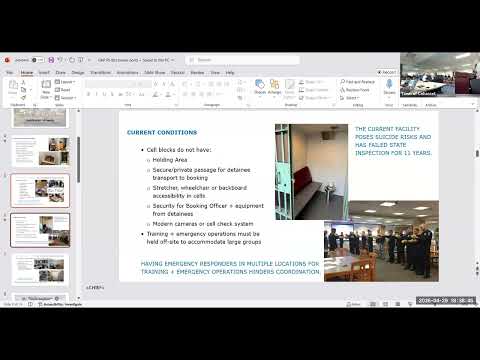
Why it matters: presenters said the current Elm Street building—originally designed in the 1960s—fails to meet modern operational, safety and accessibility requirements. Commander Greg Lennon described cramped, multiuse spaces where officers must conduct training, eat and process evidence in the same room and said the outdated cell area poses safety and ADA concerns. "The current infrastructure... is just not in any way, shape, or form, sufficient for our needs," Lennon said, noting evidence storage, detainee housing and interview space as persistent problems.
Officials described core design elements for the proposed facility including a secure sally port for prisoner transfer, dedicated evidence and vehicle-hold bays, an internal training room and a roughly 1,000-square-foot emergency operations center to replace the town's current EOC located in the basement of Deer Hill School. The design also includes a secondary garage bay intended to house reserve fire apparatus and help reassign ambulance coverage.
Funding and timeline: Kenshire said the working group's Article 21 request would cover the remainder of construction costs after the previously approved funds; the committee reported the town has spent about $5.4 million on design and planning and paid roughly $2.4 million to acquire the building. Officials said the town has not yet bonded the approximately $26.7 million that remains to be financed and cannot provide a final long-term debt-service total because market rates and exact borrowing timing are unknown. "We can't give that figure because what'll happen is... we haven't bonded that 26.7 million," the committee said, adding that the town expects to use a short-term construction loan and later convert to long-term financing.
Operational impacts and public questions: residents asked how the project would affect emergency medical services and response times. Presenters said the second ambulance currently kept behind Town Hall is staffed down and lacks equipment, forcing reliance on mutual aid that can take as long as 30 minutes to re-mobilize. The working group said housing the second ambulance at the new facility would allow much faster response. The fire chief (speaking during the forum) said the Elm Street work under consideration is intended as a substation capable of operating an engine and an ambulance to better distribute coverage along the Route 3A corridor.
Design drivers and space needs: attendees questioned square footage benchmarks compared with other towns. Committee members said earlier online benchmarking was inaccurate (they said some comparisons relied on automated searches) and defended the planned size, saying ADA accessibility, evidence storage and EOC needs significantly increase required space. Presenters said the police operations portion is about 15,000 square feet with an additional roughly 5,000 square feet driven by ADA, training and shared-town uses.
Next steps: the working group invited residents to review display boards and said the Article 21 request will be considered at the upcoming Town Meeting; if approved, speakers estimated construction and fit-out would take about three years before the police could move in. The forum closed with staff offering to answer follow-up questions individually.