Get Full Government Meeting Transcripts, Videos, & Alerts Forever!
Get email alerts on the Mental Health Policy topic
No spam. Unsubscribe anytime.
Baldwin County schools move to revise counseling opt-in language after state guidance
Summary
Baldwin County Public Schools staff proposed updating district policy to align with Alabama Act 2025-455 and a Sept. 29 ALSDE memo, saying routine school counseling, advisement and prevention education do not require parental opt-in while ongoing clinical therapy for students under 16 does.
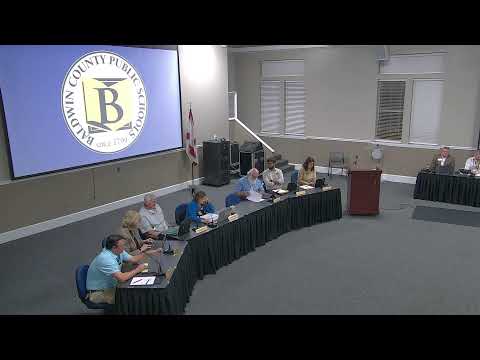
Sherry Rainbow, the district’s counseling supervisor, told the school board that the proposed policy change would bring Baldwin County Public Schools into alignment with Alabama Act 2025-455 and a Sept. 29, 2025 clarification memo from the Alabama State Department of Education. "This update will help us better serve our students while keeping our practices in full alignment with state law and the Alabama State Department of Education," Rainbow said.
Rainbow said the ALSDE memo clarifies that instruction, advisement and brief student support — described by staff as "tier one" prevention education — are regular duties of school counselors and educators and therefore are not subject to parental opt-in requirements. "If a student needs long-term clinical therapy, parental permission is required prior to referrals being made to mental health providers for any student under the age of 16," she said.
Board members raised concerns about the policy’s heading and wording, which currently reference "mental health." Several members said the term is confusing because, they argued, district counselors provide academic advisement, brief support and crisis intervention rather than ongoing clinical therapy. "We've never provided mental health from a school counselor; we refer students to outside providers," one board member said during the discussion.
Tony (a board member) urged removing the phrase "mental health" from the policy heading to avoid the appearance that counselors will provide therapy without parental consent. Nash, identified in the meeting as the district attorney, suggested drafting an explicit separate statement that the school system does not provide mental-health services and that the revised policy should instead confirm the four statutorily required prevention topics the district will teach.
Board discussion referenced four statutorily required prevention education laws noted in ALSDE guidance: Aaron’s Law, the Jamari Terrell Williams student bullying-prevention act, the Jason Flatt Act (suicide prevention), and the state drug-education requirement. Staff said the current local policy’s broader opt-in language had created delays and paperwork that prevented timely delivery of required prevention instruction to all students.
Sherry Rainbow asked the board to accept the changes indicated in the action agenda item and implement the revised policy districtwide for the remainder of the 2025–26 school year. Board members directed staff and the attorney to rework the draft policy language to clarify that routine counseling and prevention education do not require parental opt-in while continuing to require parental consent for ongoing clinical therapy or recurring mental-health treatment.
Next steps: staff said they would circulate a revised draft policy for review and work with the attorney to refine language that separates tier-one prevention education from services that require opt-in. The board did not take a final vote on the policy during the meeting.