Get Full Government Meeting Transcripts, Videos, & Alerts Forever!
Get email alerts on the Public Comments topic
No spam. Unsubscribe anytime.
Residents press commission on bike safety, housing plans and tenant rights committee
Summary
Several residents urged the commission to prioritize practical bike connections to schools and parks, preserve land for medium‑income housing, and form a tenant rights advisory committee dominated by renters to address housing safety and affordability.
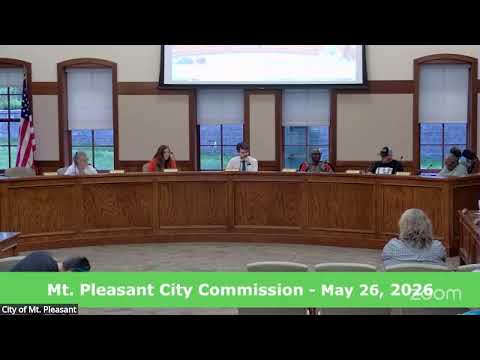
Members of the public used the May 26 comment period to press the commission on three recurring local issues: a bicycle network linking schools and parks, reuse/zoning of a 35‑acre area near Broomford and Crawford Roads for housing, and creation of a tenant rights advisory committee.
Joseph Kerion urged the commission to prioritize low‑traffic connector streets rather than high‑cost bike lanes on Mission Street, arguing that parents and children are more likely to use quiet school‑route streets. "Mission Street will always value traffic flow over safety," he said, and proposed designating existing low‑traffic streets as bicycle priority connectors to schools and parks.
Margie Notstein urged that the 35‑acre property referenced at the May 7 planning commission meeting be used to produce medium‑income housing and suggested allocating a 15‑acre tract for a school plus 20 acres for new homes to meet city housing goals. "The small amount of land Mount Pleasant has left for residential is crucial to protect," she said.
Bailey, who identified as a trans woman and tenant-advocate, urged formation of a tenant rights committee largely composed of renters to advise the commission on tenant protections and housing conditions. Bailey described recent constituent accounts of furnace failures during winter and stolen AC units in summer, and cited local renter and poverty statistics to argue for an advisory body to address systemic problems.
The commission did not take action on these citizen proposals during the May 26 meeting; commissioners acknowledged the points and, in some cases, referenced existing planning efforts (for example, corridor improvements on Mission Street) and the need to evaluate zoning and planning proposals at future hearings.
Next steps: The commission will consider planning commission proposals through standard planning and public hearing processes; the tenant rights committee proposal may be referred to staff for consideration and potential ordinance or advisory‑board drafting.