Get Full Government Meeting Transcripts, Videos, & Alerts Forever!
Get email alerts on the Public Comments And Funding topic
No spam. Unsubscribe anytime.
NVTA advisory committee reviews public comments and funding outlook for 27 project applications
Summary
At its May 27 meeting the Northern Virginia Transportation Authority technical advisory committee heard staff summarize 45 days of public comment on 27 project applications (about $1.2 billion requested) and was told a finance committee forecast of $775.8 million would likely fund projects only through the sixth or seventh rank unless other factors change.
At a May 27 meeting with no quorum, the Northern Virginia Transportation Authority’s Technical Advisory Committee heard staff present a summary of public comments submitted on 27 project applications requesting more than $1.2 billion.
Dr. Shri, who led the presentation, said the authority received a 45‑day comment period (April 2–May 17), held a May 14 public hearing where 20 people testified, and published two‑page project descriptions and supporting materials on the authority website. “We published this opportunity and encouraged people to comment,” Dr. Shri said.
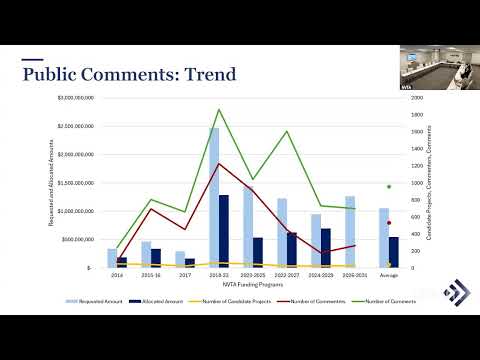
Staff told the committee that after deduplication there were about 265 distinct commenters but roughly 700 project‑level comments because many people submitted opinions on multiple projects. Those project‑level comments were summarized in charts and maps showing most support clustered near project locations and within the inner corridor; a small number of projects drew notable opposition. Staff cautioned some opposing comments were generic “no road projects” submissions that were applied across multiple road projects.
The presentation reiterated the authority’s selection framework: eligibility, a condition‑reduction (CRC) quantitative analysis that by law receives priority, a 10‑measure transaction rating, and long‑term regional benefit. Public comment is the fourth component and staff said it will be incorporated into recommendations after a careful review of each comment’s substance.
Staff also told the committee the finance committee has recommended a revenue forecast of about $775.8 million for the two‑year period. “If you just go by CRC we’ll probably reach the sixth or seventh project and run out of money,” Dr. Shri said, adding that staff will weigh other factors, including comments, when finalizing recommendations.
Staff described how partial funding has been used in prior cycles: when funds are insufficient or when community concerns suggest further design work, the authority has provided design (PE) funding but deferred right‑of‑way or construction funding until later phases. Dr. Shri said that approach allows jurisdictions to incorporate public concerns into a revised design before additional funding is released.
The committee was told staff will publish all raw comments and a staff report; the authority is scheduled to receive the staff briefing June 11, TAC will review recommendations at its June meeting (rescheduled to the fourth Wednesday), PPC will consider recommendations the following day, and the full authority is expected to decide on funding at its July 9 meeting.
The meeting concluded without any votes because a quorum was not present.