Get Full Government Meeting Transcripts, Videos, & Alerts Forever!
Get email alerts on the Land Use topic
No spam. Unsubscribe anytime.
Residents press council over proposed 48-acre industrial park during annexation hearing
Summary
An ISG representative sought annexation and rezoning of roughly 48 acres along US-78 for a light-industrial park; developer stressed jobs, sidewalks and private infrastructure, while multiple Brookshshire residents and a law-enforcement speaker raised concerns about proximity to homes, traffic, emergency access and crime.
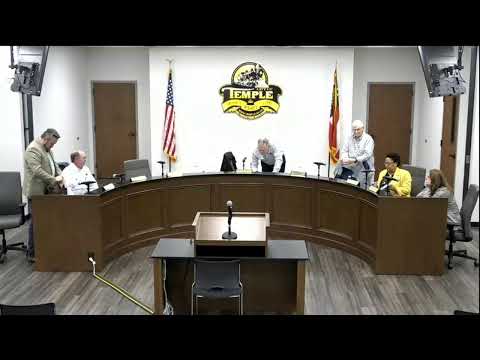
An applicant seeking annexation and rezoning of approximately 48.03 acres on U.S. Highway 78 told the Temple City Council Dec. 1 the site is suitable for a light-industrial park that would create jobs and substantially increase tax revenue, while neighborhood residents urged the council to deny or delay action because of traffic, safety and property-value concerns.
Billy Jack Bell, who identified himself as owner of Industrial Solutions Group (ISG), told the council the parcel — currently in unincorporated Harelson County — would be developed for light industrial uses. "These are light industrial, not heavy industrial. They're not smoke stacks," Bell said during his presentation, adding that sidewalks, landscaping and privately funded internal roads and utility improvements are planned and that he would be selective about tenants.
Bell said the parcel currently generates about $4,600 in annual tax revenue to the county and estimated development would raise that figure into the tens of thousands of dollars annually. He also framed the proposal around job creation and capturing economic activity now spent outside the community. Bell said access and infrastructure costs would be borne by the developer and that parcels along the state-managed corridor would be improved as part of the development.
Residents of the adjacent Brookshshire neighborhood spoke in opposition at the legally advertised public hearing. Colt Layman, whose property abuts the site, said nearly every house in Brookshshire is opposed and asked the council to increase the buffer from the current 50 feet to 200 feet. "Imagine going out on your back porch drinking a coffee and you see spotlights in a big parking lot with a bunch of 18-wheelers," Layman said.
Joe Vincent, who identified himself as a law-enforcement officer, urged caution and cited statistics he said show crime increases near industrial sites, warning that the city’s current public-safety staffing may be insufficient to handle a larger, 24/7 industrial operation. "Your public safety is going to have to respond to that many more calls," Vincent said, and listed categories including thefts, cargo thefts, labor disputes and other offenses that he argued could increase in frequency.
Other neighbors raised related concerns: potential reductions in property values, nighttime lighting, emergency-vehicle access if traffic backs up on nearby state highways and the visual impacts of a large parking lot and truck traffic directly behind established homes. Several speakers asked why any industrial buildings could not be sited farther from the subdivision or on alternate parcels.
Council staff and counsel said the hearing had been legally advertised and could proceed as an informational hearing even though the planning commission had tabled the item to its Dec. 16 meeting; council members were told they would have an opportunity to discuss and vote on the item later in the process once planning and any required notices are complete.
The hearing closed with no council vote; the planning commission will revisit the application on Dec. 16 and the council will consider next steps after that recommendation and any additional required notices or hearings.