Get Full Government Meeting Transcripts, Videos, & Alerts Forever!
Get email alerts on the Overton Brownfield Redevelopment topic
No spam. Unsubscribe anytime.
South Haven officials and state outline brownfield risks and redevelopment plan for Overton site
Summary
City staff and state brownfield officials told residents that past assessments found screening exceedances on parts of the five‑acre Overton site, described mitigation tools (grants, low‑interest loans, tax capture and engineering controls) and said the city will solicit a new development partner later this year while additional testing will be tied to specific proposals.
City staff and state officials laid out the history, environmental findings and next steps for the five‑acre Overton site at a packed South Haven town hall, answering resident questions about contamination, housing price points and state redevelopment tools.
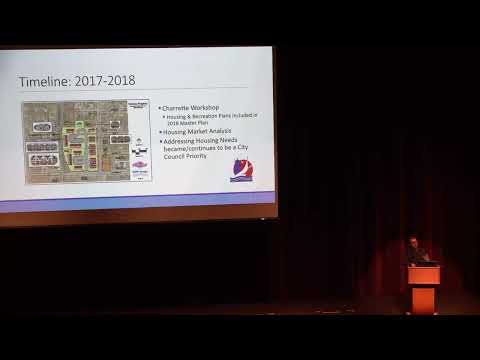
Griffin, a city presenter, summarized how the property moved from a blighted building into municipal ownership through negotiated tax foreclosure and then through a series of brownfield steps: Phase I and Phase II work, a baseline environmental assessment (BEA), a demolition and visioning that fed into the city’s 2018 master plan. Griffin said the city selected the Habitat Company as a preferred partner in 2021 but that unsuccessful low‑income housing tax credit applications in 2020 and 2023 led the city and the developer to part ways. "I hope a lot of our community recognizes and understands that this has been an ongoing process, believe it or not, almost a decade at this point," Griffin said, framing the town hall as a moment to review lessons learned and refine an RFP for a new development solicitation.
State brownfield staff outlined the tools available to make the site buildable. Doug Coop, an EGLE brownfield coordinator, described three common incentive pathways: site assessment grants, remediation grants/loans and tax‑increment capture. He said EGLE’s site assessment program has been used across the state to provide Phase I/II work and baseline environmental assessments to inform decisions about redevelopment. "We also have loans that are available... at a 1.5% interest," Doug said, adding that grant dollars and tax financing can be combined to lower developer risk.
EGLE’s technical analyst, Rachel, explained how risk is evaluated and when mitigation is required. She described the three elements of a pathway — contaminant, transport pathway and a receptor — and reviewed five pathways examined at the site: ambient air/vapor, indoor air, drinking water, groundwater/surface‑water interface, and direct contact. She emphasized that screening numbers are set to protect the most sensitive residential receptor (a child) and that mitigation options range from removal of hot spots to engineered barriers and vapor‑mitigation systems. Rachel told the room that data from the 2015 BEA and an environmental site assessment completed in October 2023 showed exceedances of screening criteria for some pathways and that what must be done depends on the proposed development and the receptor scenario.
Residents pressed officials on groundwater migration, neighboring property impacts and whether real‑estate sellers and agents are required to disclose contamination. An EGLE representative answered that there is not an across‑the‑board state disclosure statute that automatically governs every sale; responsibilities depend on who caused contamination and other legal details. Officials said further testing and mitigation are typically tied to a specific development proposal: developers commonly fund or require additional targeted testing and then propose site‑specific mitigation measures to eliminate exposure pathways.
City staff and MEDC redevelopment staff also described non‑environmental redevelopment concerns raised during prior work: unit density, price points and management of shared systems. The city said it had refined its vision after community feedback and a February workshop and plans to issue a new solicitation for a development partner later this calendar year. The MEDC redevelopment services director described pre‑development assistance MEDC can provide — drafting RFPs/RFQs, site design, financial analysis and targeted funding to remove pre‑development barriers — for communities designated as priority redevelopment sites.
What happens next: the city will post tonight’s materials on its website, the presentations and contact information for state staff; additional testing and specific remediation measures will be driven by developers’ proposals and by EGLE’s technical review. City staff said they will incorporate lessons from the prior project review and the state’s technical findings as they draft the next RFP.
Sources: presentations and exchanges at the South Haven town hall. The principal speakers were Griffin (city staff), EGLE brownfield coordinator Doug Coop and EGLE technical analyst Rachel. The town hall included a public question period and multiple resident comments.