Get Full Government Meeting Transcripts, Videos, & Alerts Forever!
Get email alerts on the Erosion Controls And Occupancy topic
No spam. Unsubscribe anytime.
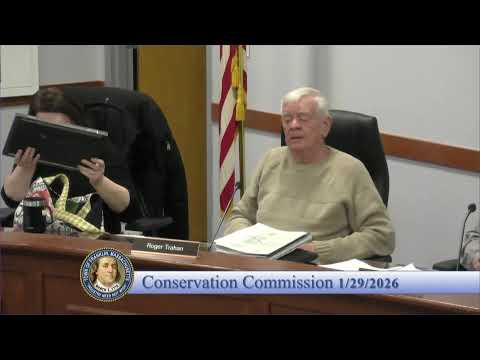
Conservation Commission approves NOI for 444 East Central Street after debate over erosion controls and O&M timing
Summary
The Franklin Conservation Commission on Jan. 29 approved the Notice of Intent for 444 East Central Street after revising special conditions to allow the applicant discretion to install biodegradable erosion controls, clarifying storm‑inspection timing per EPA guidance, and requiring a final operations and maintenance plan prior to the first certificate of occupancy.
The Franklin Conservation Commission voted to approve the Notice of Intent for 444 East Central Street at its Jan. 29 meeting, adopting updated special conditions that address erosion controls, inspection timing, and site operations.
Commissioners and staff spent the bulk of the public hearing debating Condition 20, which originally required biodegradable erosion‑control barriers where they protected resource areas. A consultant showed a plan exhibit distinguishing biodegradable controls (mapped in green, about 2,750 sq ft) from perimeter non‑biodegradable controls (orange). Applicant representative AJ Alizo asked that the condition be revised to allow the applicant to install biodegradable erosion and sedimentation controls sitewide “at its discretion,” citing bidding flexibility; commissioners agreed to add language offering that optionality.
Why it matters: the change balances the commission’s preference for biodegradable materials near resource areas with practical cost and procurement considerations raised by the applicant. The commission kept performance‑focused requirements: erosion controls must be installed per the approved erosion control exhibit and inspected/approved by a licensed professional prior to disturbance.
Staff also pressed for clarity on inspection frequency. The commission adopted language requiring contractor and third‑party inspection cadence that achieves effectively weekly site oversight—specifically, inspections once every 14 calendar days plus inspections within 24 hours of qualifying storm events—while clarifying inspections are required during the project’s normal working hours, consistent with EPA guidance. Staff proposed alternating contractor and peer‑review inspections so the site is inspected each week without duplicative weekly payments.
On operations and occupancy, the commission clarified that wetland replication must be completed prior to the final certificate of occupancy, but acknowledged the project will proceed with phased or building‑by‑building certificates of occupancy. The commission required the applicant to submit and receive approval of a final operations and maintenance (O&M) plan prior to the first certificate of occupancy; the O&M must include mowing schedules near replication areas, the timing and permanent removal/storage of a dock from the perennial stream, and contact information for the property manager. The commission also required a two‑year monitoring period for replication areas, which may run after individual certificates of occupancy are issued.
Administrative items finalized in the order of conditions included requirements for a chapter 91 license for the dock if installed before a final CO, signage for replication and buffer zones, snow‑storage limits (outside the 100‑ft buffer), and the prohibition on rock salt within 100 ft of wetland resources without prior written approval.
The commission also discussed peer‑review fees; the applicant indicated a check would be provided and staff and applicant agreed to reconcile fee status within the commission’s 21‑day decision period. After reading the revised special conditions aloud, the commission closed the public hearing and voted to approve the NOI with the updated conditions. Chair Le Page and commissioners thanked applicants and consultants for their time and cooperation.
Next steps: the applicant must install and certify erosion controls per the approved exhibit, submit the final O&M plan for approval before the first certificate of occupancy, complete wetland replication per the order of conditions before the final CO, and comply with monitoring and reporting requirements outlined in the approved conditions.