Get Full Government Meeting Transcripts, Videos, & Alerts Forever!
Get email alerts on the Transit Infrastructure topic
No spam. Unsubscribe anytime.
MBTA to close Symphony Station May 30 for multi-year accessibility, safety overhaul
Summary
MBTA project staff told neighbors the Symphony Station overhaul will add four elevators, raised platforms, restrooms and new street-level headhouses; the station will close May 30 and remain out of service through summer 2029 with final completion expected in 2030, officials said at a public meeting.
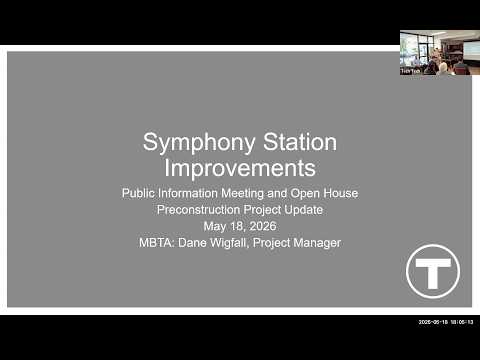
The Massachusetts Bay Transportation Authority on Wednesday outlined a multiyear renovation of Symphony Station that will close the station beginning May 30 for phased construction and keep it closed until the summer of 2029, with final completion scheduled for 2030, MBTA staff said at a public information meeting.
Project manager Dane Wigfall, who leads the Symphony Station accessibility improvement project, said the overhaul will add four elevators (one at each corner), raise platforms for level boarding, install public restrooms, improve lighting and signage, and upgrade electrical systems to meet modern safety and accessibility standards. “Most importantly, additional egresses and safety enhancements will result in an increased level of safety to station users,” Wigfall said.
The improvements are intended to bring the nearly 85-year-old underground station into compliance with current building and emergency-egress codes and the Americans with Disabilities Act, project staff said. Engineer Ken of Thornton Tomasetti showed renderings of new elevator headhouses at Massachusetts Avenue and Huntington Avenue, renovated and new stairways, and expanded inbound and outbound lobbies with attendant rooms and new fareline gates.
Dan Weikart, representing the MBTA project team, summarized construction timing: “Symphony Station will be closed starting May 30th. It will remain closed until the summer of 2029. Final completion will be in 2030,” he said. Staff said there will be at least one partial reopening before final completion. Early work zones will require lane takes on Huntington Avenue and temporary changes to bike lanes and pedestrian routes.
Service alternatives and rider guidance
MBTA staff listed nearby alternatives for riders during the closure: Massachusetts Avenue (Orange Line) station, Prudential Station (about a six-minute walk), Northeastern Station (about a six-minute walk) and Hynes Convention Center (about an eight-minute walk). The project team also pointed to bus routes 39 (which parallels the E branch) and 1 (along Mass Ave) as surface options.
Quentin Lively, deputy chief of integrated transit programs, said the project team has conducted outreach during design and that utility relocation work is already underway. “This project's been in design for years now; there's been a lot of community outreach,” Lively said when responding to questions about resident consultation.
Construction impacts, hours and mitigation
Contractor Dan Rice of Suffolk Construction described phased work zones. He said initial zones will take two lanes on Huntington Avenue and affect a bike lane and a partial drive lane on Mass Ave for about 16 months before traffic configurations shift as the project advances. Rice said alternate pedestrian routes will be marked and that police details will be used to guide pedestrians and cyclists near active work areas.
Typical work hours were described as roughly 7:00 a.m. to 3:30 p.m., with occasional extended days up to about 5:00 p.m. and limited weekend or night work only as needed. The MBTA also said it will maintain a vibration-monitoring program and coordinate with large nearby event venues such as the Boston Symphony Orchestra to avoid noisy work during performances.
Community questions and MBTA responses
Residents raised several practical concerns at the meeting. Multiple guests asked whether the MBTA would provide shuttle buses between major nearby stations; staff said there were no current plans for dedicated MBTA shuttles and encouraged riders to use nearby subway stations and existing bus routes, but said they would forward requests to the bus operations team for further consideration.
A resident who asked about pest control was told the contractor is already deploying rodent traps and will add more as earthwork intensifies. “We are actually already have rodent traps set up and we'll be adding more of them as construction continues to manage that problem,” a project representative said.
Kim Kerrigan, who identified herself as a spokesperson for Symphony Plaza West residents, raised multiple quality-of-life concerns including porta-potties placed near building entries, subcontractor parking that she said repeatedly blocked a fire hydrant, and inconsistent enforcement by police. Kerrigan said the placement of temporary facilities and on-street contractor behavior raised safety and access worries for residents; MBTA staff said they would be mindful of those complaints and work to address them.
Accessibility and pedestrian circulation
Several attendees and neighborhood representatives urged careful design of pedestrian detours to accommodate elderly or mobility-impaired patrons, and asked staff to coordinate with cultural institutions. Kelly Brilliant, co-executive director of the Fenway Alliance, asked the team to prioritize safe, clear walking routes for older patrons of the BSO and Huntington Theatre and to coordinate around the BSO’s holiday season to minimize disruption during peak events. Project staff said they meet regularly with venue representatives and will avoid noisy work during performances.
Information access and next steps
Project staff said presentation slides and the recorded meeting will be posted on the project website and that the team will remain available after the session to answer questions. Attendees were given a construction hotline and an email (capitalengagement@mbta.com) for follow-up. Staff also said they maintain a construction management office on Huntington Avenue at Gainsborough for day-to-day coordination.
What remains unresolved
Staff repeatedly said there are no planned changes to bus stop locations as part of the project; attendees pressed for clarification about specific stops (including a frequently cited Gainsborough stop) and asked the MBTA bus team to evaluate capacity and frequency during the multi-year closure. The MBTA said it would pass those requests to the bus operations group but had no immediate service changes to announce.
The project team encouraged continued engagement: boards remained on display after the presentation, subject-matter experts were available to take additional questions, and staff committed to posting materials and the recording publicly after the meeting.