Get Full Government Meeting Transcripts, Videos, & Alerts Forever!
Get email alerts on the Rocky Community Farm topic
No spam. Unsubscribe anytime.
Rocky Hill community farm update: raised‑bed funding, porta‑potty and septic costs slow progress
Summary
At the Feb. 24 subcommittee meeting staff reported limited progress at the Rocky Community Farm due to weather and outlined key operational constraints: in‑person registration, uncertainty over raised‑bed funding, porta‑potty costs and septic/holding‑tank options.
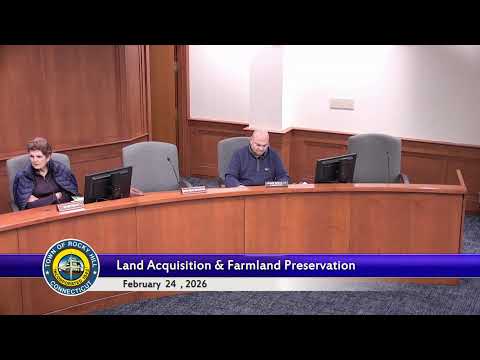
At the Feb. 24 Open Space, Land Acquisition and Farmland Preservation Subcommittee meeting, a town staff presenter gave an operational update on the Rocky Community Farm, saying little changed over the past month and that several practical and cost questions remain unresolved.
The presenter said registration for garden plots is ready but must be completed in‑person: "they take checks. Um, but you have to come in in person and register here. You cannot mail a check in. It has to be in person at the uh desk downstairs for them to take checks." He also said raised‑bed funding is not yet in place and suggested using proceeds from lot sales next year or opting for lower beds to reduce costs.
The presenter outlined porta‑potty options and recurring charges in the budget: "Craig has in his budget for standard and ADA portaotties or $70 a month for standard, $100 a month for ADA," and added that more elaborate flushing units cost roughly $400 a month and high‑end units "$4,000 a month." He confirmed cleanouts are billed per service.
On sewage the presenter described two pathways: engineered septic systems or holding tanks. He said an engineered septic "is going to be between 30 and $50,000," and that many locations on the site appear to need engineered systems because of ledge and compaction. As an alternative he said state staff were "not opposed to a holding tank" and estimated a holding tank "somewhere between best we can gather right now 2500 $400 to $5,000" but noted pumps, alarms and recurring pump/cleaning costs would apply.
Water service and site logistics remain unresolved. The presenter said the plan assumes a new tap and shutoff from the hydrant to serve the barn and fields but that the town is still working through contractor lists and an incorrectly installed line that needs correction. He noted a local contractor estimated about a 15% savings if town crews supplied excavation but warned about overtime and supervision costs.
Committee members asked whether the town could solicit donated raised beds or have the town crew do excavation. The presenter said there is some money in the account and that proceeds from plot fees should be returned to the farm budget; he also said a town crew member named Joe offered to help with digging.
Trails work on the property was deferred: the manager prefers to postpone trail development until core operations (plots, water, sanitation) are resolved to avoid disturbing current lessees. The committee discussed returning to trail planning in a later season.
Next steps: town staff will confirm porta‑potty cleanout schedules and costs, continue outreach to communities with holding‑tank experience for operational schedules, and firm up timing for plot applications when the town registration system is ready.