Get Full Government Meeting Transcripts, Videos, & Alerts Forever!
Get email alerts on the Dementia Training topic
No spam. Unsubscribe anytime.
Tribal programs in Wisconsin adopt Virtual Dementia Tour to boost empathy and training
Summary
Presenters from the Great Lakes Inter-Tribal Council (GLITC) and the Onida Nation described using the evidence-based Virtual Dementia Tour (VDT) to train staff, elders and youth; they reported about 20 trained facilitators and roughly 200 participants in under two years and emphasized tailored debriefs and cultural adaptations.
Amber Hoon, tribal dementia program coordinator for the Great Lakes Inter-Tribal Council (GLITC), and Carrie Lindsay, long-term care case management program manager for the Onida Nation, described how tribal programs in Wisconsin implemented the evidence-based Virtual Dementia Tour (VDT) to build community understanding of dementia.
Hoon said GLITC received an Administration for Community Living (ACL) Tribal Alzheimer's Disease Program Initiatives grant in June 2020 and began work after she was hired in August 2020. GLITC's work plan focused on three goals: introduce the Savvy Caregiver in Indian Country, offer the VDT to tribal communities and create a sustainable model by training tribal staff as facilitators.
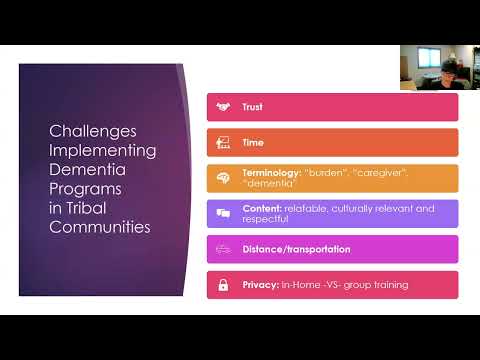
Hoon described early barriers to outreach and participation: "The time taken to listen and learn was worth it," she said, recounting an extended conversation with an elder that led to referrals and ongoing engagement. She said terminology and cultural relevance mattered: words such as "caregiver" or "burden" sometimes alienated family members, so trainers used terms like "brain health" or "informal caregiver" depending on the audience.
Hoon explained the VDT method: participants don sensory "garb," complete timed tasks designed to simulate mid-to-late-stage dementia, then remove the garb and take part in a structured debrief. She emphasized that the debrief is the primary educational moment: the experience itself raises emotions, and the debrief shapes learning and next steps.
On implementation, Hoon described a phased rollout: she completed online facilitator training and a certification process, then trained GLITC staff and partnered with Wisconsin Department of Health Services tribal dementia care specialists and local senior programs. Hoon reported roughly 20 tribal staff trained to facilitate and "approximately 200 community members and tribal staff" who experienced the VDT within about two years; she said most Wisconsin tribal dementia care specialists are now trained and communities beyond Wisconsin have requested events.
Carrie Lindsay described Onida Nation's experience delivering the VDT. Onida used state funding for a tribal dementia care specialist and brought staff and medical providers through the VDT in 2023. She said additional social workers and a registered nurse trained as facilitators in early 2024, allowing broader in-house delivery. Lindsay summarized staff reactions: the experience prompted increased empathy and practical care changes, including patience and altered approaches to communication with people living with dementia.
Both presenters highlighted access and safety adaptations. Hoon and Lindsay said the training can be offered one-on-one or in groups and that debriefing should be tailored; Lindsay said she often prefers one-on-one debriefs because some participants "really needed that one-on-one talk time." They also described minor modifications to the garb or protocol when participants have health or trauma concerns (for example, using headphones without sound or removing a piece that could exacerbate a health condition).
Both presenters recommended repeating VDT experiences periodically (annually or semiannually) to reinforce learning and accommodate staff turnover. They described youth events as possible when communities request them, with consent forms adapted for parents/guardians and single-participant runs to avoid distraction.
The webinar emphasized two practical points for jurisdictions considering VDT: first, outreach and trust-building in tribal communities take time and often require flexible delivery (home visits, one-on-one sessions); second, pairing the sensory simulation with a culturally informed debrief is central to converting the experience into changed practice. For follow-up, the presenters pointed participants to Second Wind Dreams (the VDT vendor) and offered their contact information.