Get Full Government Meeting Transcripts, Videos, & Alerts Forever!
Get email alerts on the Freedom Of Information Training topic
No spam. Unsubscribe anytime.
Freedom of Information Commission director outlines Connecticut rules for public meetings and records
Summary
A state FOI Commission director led a training explaining what counts as a public meeting or public record in Connecticut, the commission's complaint powers, remote‑meeting rules, executive session limits and common exemptions such as teacher evaluations and attorney‑client privilege.
The Freedom of Information Commission director led a training for town officers and volunteers on Connecticut’s open‑government rules, explaining how the Freedom of Information Act defines public meetings and records and how the commission enforces compliance.
Why it matters: The guidance spelled out when discussions must be held in public, how online and hybrid meetings must be posted and recorded, what records towns must provide (including emails and texts on personal devices when they concern public business), and the limited circumstances that justify withholding records. The director emphasized the commission’s preference for education and voluntary compliance but said the agency can order production of records and impose fines up to $5,000 per violation in egregious cases.
The presenter, identified as the director of the Freedom of Information Commission, began by tracing the law’s origins to 1975 and said the commission’s core duties include educating officials, handling complaints and, when necessary, holding evidentiary hearings. “Our sole responsibility, we’re a state agency,” the director said, explaining the commission processes complaints from residents, attorneys and town employees and seeks remedies that range from remedial training to orders to produce records or fines.
The training laid out key operational rules for municipal boards. A “meeting” under FOI occurs when a quorum or majority of board members discuss public business, the director said, warning that email and text‑message chains among a quorum can create an illegal, undocumented meeting. She advised that if board members need to learn about an issue, the first public airing of that discussion should generally be at the posted meeting—“that’s the whole point of FOI.”
On public participation the director clarified that attendees have a right to be present but no statutory right under FOI to speak; public‑comment procedures (time limits, name/address requirements) are local decisions. She also advised boards to accommodate overflow attendance—by changing venues or providing remote access—rather than proceeding in a room that is overcapacity.
Remote and hybrid meetings: If a meeting includes a virtual participation link, that link is considered a meeting location and must be listed in the agenda and on the town website, the director said. Online‑only meetings must be recorded under FOI; other recording obligations may come from separate statutes (for example, land‑use boards). She cautioned that microphones left on during breaks can capture off‑the‑record comments: describing a case where commissioners’ recess remarks about a developer leaked, she said the commission ordered disclosure of the full recording after a requester demanded the original file.
Executive sessions and minutes: Executive sessions are permitted for specific reasons—pending litigation, personnel matters, attorney‑client communications, security concerns and certain property negotiations—but a two‑thirds vote and a sufficiently descriptive agenda item are required so the public is fairly apprised of the topic. Votes must be taken in public and minutes must record votes and attendance; the commission will not typically hear complaints based solely on the perceived level of narrative detail in minutes.
Public records and requests: The director stressed that any recorded data related to the conduct of public business—emails, text messages and recordings—are public records and can be requested. Board members’ personal devices are not an exemption: messages about public business may be subject to disclosure. Requests must be acknowledged within four business days (failure to respond counts as a denial) and records should be provided promptly, a reasonableness standard that depends on scope and administrative burdens. Fees typically cover copying and outside contractor costs, not staff time.
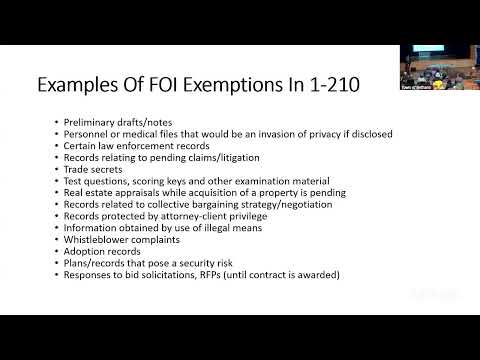
Exemptions and pitfalls: The director reviewed common exemptions (FERPA, HIPAA, law‑enforcement protections, attorney‑client privilege) and highlighted statutory quirks such as a state exemption for public‑school teacher evaluations (those are not public) while other public‑employee evaluations generally are. She warned that publicly discussing a confidential attorney opinion at a meeting can waive privilege and convert the opinion into a public record.
The session closed with the director repeating contact information and encouraging officials to call the commission for guidance; she said much of the commission’s work is educational and that early consultation can prevent complaints and hearings.