Get Full Government Meeting Transcripts, Videos, & Alerts Forever!
Get email alerts on the General Plan topic
No spam. Unsubscribe anytime.
Residents and advisory group urge Merced vision to prioritize affordable housing, equity and youth services
Summary
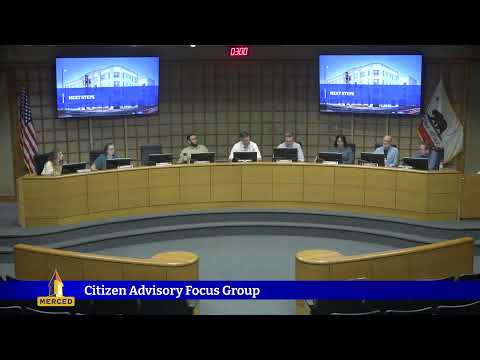
At a May 27, 2026 Citizen Advisory Focus Group meeting, consultants read a draft vision for Merced's general plan and residents and CAFG members urged stronger commitments on affordable housing, environmental justice (SB1000), youth services, safety and city investment across neighborhoods. The CAFG asked consultants to revise the draft for a 30-day public review.
Members of Merced City's Citizen Advisory Focus Group and several public commenters pressed consultants on May 27 to make the city's draft vision statement for its 2050 general plan more explicit about affordable housing, environmental justice and services for young people.
"With great power comes great responsibility," said Norma Cardona, a downtown resident, small-business owner and community leader, thanking the CAFG for its ongoing participation and urging the group to adopt a vision that protects long-term residents and the environment.
Consultant Michael Gibbons (Mintier Harish) read a three-paragraph draft that describes Merced as "standing at the forefront of a new era in central California," highlights downtown as a cultural and economic jewel and calls for "intentional, balanced, sustainable and inclusive" growth anchored by local colleges and the city's agricultural and transportation assets. After the reading, CAFG members and members of the public offered detailed edits and policy priorities they want reflected in a revised draft.
Why it matters: The vision statement will guide the general plan's later goals, policies and programs and will be used by the planning commission and city council to evaluate future development and investments. Several speakers said the draft read as aspirational but lacked concrete commitments that would protect low-income and historically disadvantaged neighborhoods.
Public commenters told the CAFG the draft should explicitly address environmental justice and tenant protections. One resident, speaking without a name on the record, cited state law SB1000 and said 14 census tracts in Merced qualify as environmental-justice communities; the commenter urged zoning and policies that reduce lead-based paint exposure and stop displacement. The same public commenter and others also raised SB35 in arguing the city needs to produce more affordable housing.
CAFG members urged specific wording changes and additions. Member Mr. Thomas and others said the draft's frequent phrasing that Merced "will continue" felt passive; they recommended stronger, affirmative language and measurable commitments. Suggestions from the CAFG and the public included:
- Add explicit commitments to affordable housing near transit, and to increase the share of housing that is affordable to low- and moderate-income households (public commenters noted past production rates of roughly 4.3% and 6.3% in prior cycles, which they said were insufficient).
- Strengthen language on environmental justice and remediation (lead-based paint removal and inspection), and recognize the city's linguistic and cultural diversity in public spaces and programming.
- Prioritize youth services, jobs and safe, free public gathering spaces so young residents have alternatives to risky behaviors.
- Make clear the city will invest public resources (not rely solely on private investment) to create parks, trails and neighborhood amenities, and bridge access gaps between North and South Merced.
- Replace or refine generic references to "expanding industrial and technological sectors" with locally appropriate economic anchors such as health care, education and local-serving businesses, and emphasize equitable, non-polluting job growth.
Consultants' response and next steps: Michael Gibbons summarized the feedback and said the consultant team would revise the draft to reflect CAFG and public input, then the city will publish the revised vision for a 30-day public review period. The consultant indicated the next formal steps include planning commission review and then city council consideration, with a target timeline that could include council action in September.
Votes at a glance: - Approval of CAFG minutes (Feb. 25, 2026): motion made and seconded; chair announced the motion passed unanimously (voice vote). - Annual attendance report (F2): motion to approve made by Mr. Greg and seconded by Mr. Maxi; the CAFG approved the attendance report unanimously.
What was not decided: The meeting produced no formal policy changes or binding commitments; the session collected edits and community priorities to be incorporated into a revised draft for public review. Several legal and numerical claims raised by public speakers (for example, local SB35 compliance and specific past production percentages) were presented as assertions and not adjudicated or verified at the meeting.
The meeting adjourned at 7:33 p.m. The consultants asked CAFG members and the public to submit any written suggestions; staff and the consultant team will circulate a revised draft for further review.