Maynard planning board continues Powder Mill overlay hearing after zoning clarifications
Summary
The Maynard Planning Board continued the Powder Mill Overlay District public hearing to Aug. 26 after staff detailed textual edits — including exemptions for single‑family/duplex units, clarified dimensional tables and a proposed trigger for design standards — and members debated map timing and two parcels near the John Deere site.
The Maynard Planning Board on July 22 agreed to continue the public hearing on the Powder Mill Overlay District (PMOD) to Aug. 26 after staff walked the board through a series of draft edits to the zoning text and members raised questions about mapping and implementation.
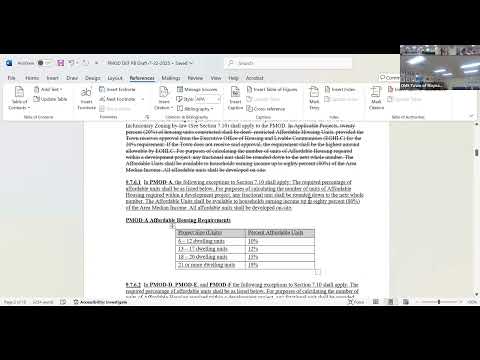
The board heard from Bill Crrenshaw, who summarized the changes as largely editorial: site‑plan language was clarified to exempt single‑family and duplex dwellings, dimensional tables were updated to align with the town’s primary zoning table, and language about open space adjacent to the Assabet River was adjusted to reflect a roughly 175‑foot setback rather than the 150 feet discussed previously. "None of [the edits] seem to be more constrictive," Crrenshaw said, describing many changes as clarifications and consistency fixes.
Why it matters: the PMOD would overlay existing zoning near the river and establish form and use rules intended to guide redevelopment of large parcels. Board members focused on two high‑impact implementation questions: how to define the threshold that triggers the PMOD design standards, and how overlay permissions intersect with the underlying zoning for parcels near the John Deere site.
On the design‑standard trigger, staff proposed that PMOD standards apply to development that "consists of more than 50,000 square feet of land area (not including open space) or more than 10,000 gross square feet of new or expanded buildings." Members discussed whether substantial renovations, changes of use or multi‑stage redevelopment should be caught by that language and agreed to refine the definition before a final vote.
Board members also debated whether site‑plan approval requirements (section 10.5) should apply broadly within the overlay and whether parking thresholds would inadvertently trigger review for small projects. Several members recommended keeping the overlay’s exemptions for single‑family and duplex units explicit and simplifying language so the PMOD applies only to projects that opt into or meet the stated size thresholds.
Mapping and timing were decisive. The board said it cannot act on the map amendment portion of the proposal because a map posting error prevents the hearing from proceeding. The board moved — and voted by roll call — to continue the PMOD zoning text and associated map amendment to Aug. 26 at 7 p.m. The roll call votes were recorded on the public record.
Public comment: Abby Barrett signed on online and said she had no comment but noted she was unsure where some subdistrict labels appeared on the public map; staff displayed the map and walked through districts EDNF, E and F on screen.
What’s next: staff will incorporate the drafting clarifications and return with updated text and the corrected map for the Aug. 26 meeting. The board’s continued review will include a refined definition of "new development" for the overlay and any related amendments to the zoning definitions.
Votes at a glance: the board recorded a roll‑call vote to continue the PMOD and map amendment to Aug. 26; the board also approved the June 10 minutes as amended earlier in the meeting (recorded as "four to zero" on the minutes vote, with members who were not present recorded as not voting).
AI generated
The text on this page is AI generated. Summaries, highlights, analysis, and video transcripts are all produced from the original source material.
AI can make mistakes, so if you spot one, and we will fix it for everyone.
Note: the source content is unaltered by us. Any content source we link to, be it a video, an audio recording, or a document, is presented exactly as its publisher released it. That publisher is usually a government body, sometimes an individual official or another organisation.