Get Full Government Meeting Transcripts, Videos, & Alerts Forever!
Get email alerts on the Economic Development Data Center topic
No spam. Unsubscribe anytime.
Residents, experts and council members press for transparency and environmental review as data-center overlay is discussed
Summary
Public commenters raised ownership, tax-exemption and environmental concerns about a proposed data-center overlay, asking for clearer records, independent environmental review, and full accounting of potential lost local tax revenue before council advances approvals.
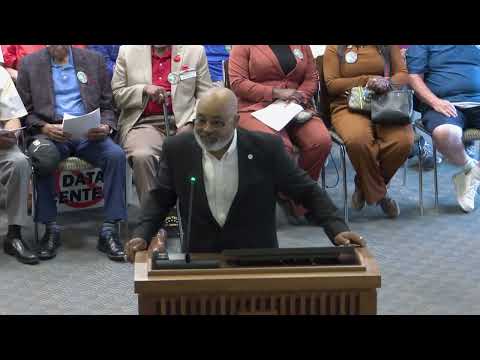
A long string of public commenters and local advocates used the May 26 Columbus City Council meeting to press for greater transparency, independent environmental review and clearer fiscal accounting related to a proposed data-center overlay and associated incentives.
Paul Olsen detailed county-record discrepancies around a major land sale tied to the project and raised questions about whether a series of quick ownership transfers could indicate a "straw buyer" pattern. He urged the council to verify deed records and ownership chains and to explain how local tax revenues could be affected if large projects claim exemptions.
Multiple speakers — including Kim Hicks and other attendees who cited academic and government reports — urged the council to weigh air-quality, water, noise and utility impacts. Presentations referenced peer-reviewed and policy analyses showing potential public-health burdens from increased emissions, the cost of utility upgrades passed to ratepayers, and localized "heat-island" effects in communities near hyperscale facilities.
Other public commenters asked why the chamber of commerce is running an advisory committee on the overlay and requested clearer separation between private promotional work and public decision-making. Darlene Leard asked the council to publicly clarify the roles and responsibilities of Choose Columbus, the Economic Development Authority and any private committees making recommendations to council, saying that minutes and public records must be complete and accessible under Georgia law.
Items of note for council and staff follow-up: - Several speakers demanded an independent environmental and health impact assessment covering air emissions, backup-generator use, water withdrawals and noise impacts; they urged the city not to treat state-level rules as a substitute for local review. (public comment) - Concerned residents asked staff to quantify potential lost local revenue if state tax incentives or exemptions remove local-option sales taxes and to explain how reclamation bonds and decommissioning obligations would be enforced. (public comment) - Some commenters requested that the city require clear, recorded ownership chains and that any proposed financing or incentive agreements be published in full for public review before council acts.
Council did not take final action on the overlay during the May 26 meeting. Instead, council members and staff acknowledged multiple outstanding information requests and a need to ensure public records, clarify decision-making authority, and commission additional technical analysis where necessary.
What’s next: residents asked council to post full development-authority records and to ensure all advisory-group meetings and recommendations are visible to the public. Staff and council signaled they will return with clarifications on which entity exercises final decision-making authority and how tax incentives and reclamation obligations will be administered and enforced.