Get Full Government Meeting Transcripts, Videos, & Alerts Forever!
Get email alerts on the City Budget topic
No spam. Unsubscribe anytime.
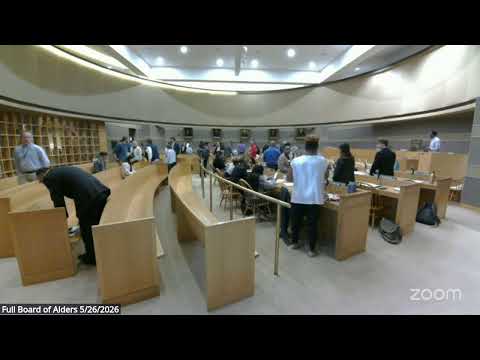
New Haven alder body accepts Yale's seven-year voluntary payment plan and approves $744.3 million budget
Summary
The New Haven Board of Alders approved a finance package that accepts a voluntary payment arrangement with Yale University totaling $232 million over seven years and passed an amended FY2026'27 operating budget of $744,291,420. Debate centered on how to use one-time state and university contributions, education funding levels and whether to make a climate office post permanent.
The New Haven Board of Alders on a single evening approved a finance package that both accepts a seven-year voluntary payment agreement from Yale University and adopts the city's fiscal 2026'27 operating budget.
The board voted to accept a finance committee recommendation to authorize the city to receive voluntary payments from Yale that the finance chair described as "more than $5 million more per year above current levels, totaling $232 million over seven years." The agreement continues the university's practice of making payments to mitigate lost tax revenue when it acquires properties that become tax-exempt, and includes commitments to explore housing opportunities on Yale land and to provide financial and technical support to community nonprofits. (Finance Chair)
The board then approved Appropriating Ordinance No. 1 as amended by the finance committee, producing a general fund budget of $744,291,420 for the coming fiscal year and municipal tax rates of 39.962 mills on real and personal property and 32.46 mills on motor vehicles. The finance chair told colleagues the committee's amendments reflect technical corrections, newly identified state and Yale funds, and a trimmed set of new personnel requests.
Key allocations in the amended package include a committee decision to increase Board of Education support by $7.9 million while placing $6 million into the general fund balance to be assigned for educational use. The chair said the committee had originally considered a $13.9 million increase but split that amount to balance immediate school needs with fiscal discipline.
The budget debate produced several high-profile amendments. One proposed amendment to add an $80,000 deputy director position in the Office of Climate and Sustainability (to be funded by reducing the central utilities electricity line) drew extensive debate. Supporters said the position is necessary to deliver a series of solar projects, manage roughly $15 million in active grants, and capture projected energy and lease revenues; opponents argued the role was initially ARPA-funded and should remain grant-supported while the city addresses long-term structural deficits. After a roll-call vote, the amendment failed and the budget remained as amended by the finance committee.
Another amendment sought to use roughly $4.7 million from the Board of Education fund balance to hold the mill rate at 39.4 mills; proponents framed it as modest relief for residents, while opponents said it would undercut school funding and postpone structural fiscal fixes. That amendment also failed in a roll call.
Supporters of the final budget cited compromises that preserved services and added targeted investments: $350,000 for youth employment, funding to support expansion of teen programming, and an allocation to create a senior center in the Hill neighborhood. Several alderpersons also thanked the state delegation for what the finance chair described as $22 million in state assistance that helped reduce the mill-rate increase compared with the mayor's original proposal.
The board also approved related finance measures recommended by the committee: the tax levy and revenue ordinance for FY 2026'27 (Appropriating Ordinance No. 2), a capital/borrowing ordinance authorizing no new borrowing while permitting refinancing opportunities (Ordinance No. 3), and an ordinance permitting short-term tax or grant anticipation notes (Ordinance No. 4). The package included fee schedule changes (including waivers for certain vital records for vulnerable New Haven residents and new resident ID charges) and a reallocation of $2,900,000 in ARPA funds from lower-priority projects to projects that are on track to spend their allocations.
The board held a moment of silence for longtime local media figure Bob McCorm and heard community announcements before adjourning.
What happens next: The city will implement the approved operating budget for July 1, 2026 through June 30, 2027 and proceed with administrative steps needed to receive Yale's voluntary contributions under the terms described to the body. The board did not adopt the proposed permanent funding for the deputy director in the climate office; that position remains subject to the city's funding plan and future budget deliberations.