Get Full Government Meeting Transcripts, Videos, & Alerts Forever!
Get email alerts on the Utility Governance topic
No spam. Unsubscribe anytime.
Watertown committee proposes tiered litigation safeguards and forecasting after $36.4M Waterberry settlement
Summary
A five‑member Watertown water and sewer committee recommended townwide and WSA‑specific risk‑management policies, tiered litigation review thresholds and a public communications plan to prevent another costly dispute with Waterberry; public commenters urged changes to tone and legal leadership before council adoption.
Watertown’s bipartisan Water and Sewer committee presented a package of recommendations March 23 aimed at preventing another multi‑year legal fight with neighboring Waterberry that left the town with about $36.4 million in liabilities.
The committee’s executive summary said the dispute began after Watertown ended discounted bulk rates in 2018 and Waterberry raised wholesale water and sewer charges; litigation culminated in a late‑2025 payment in the tens of millions, including a $30.6 million payment mentioned during the presentation. The committee was formed by the town council to recommend safeguards, strengthen governance and improve public communication.
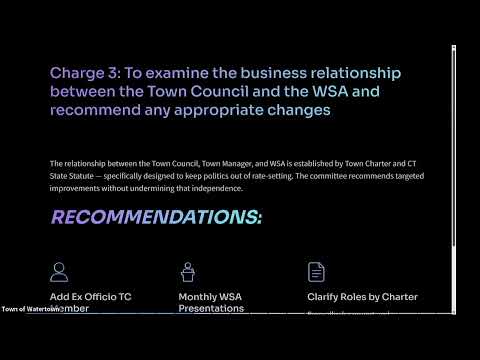
The committee grouped its work into three charges. For risk management, it recommended a townwide risk‑management policy, a WSA‑specific policy (a draft in attachment 10), and multi‑year financial forecasting so long‑term rate pressures, infrastructure costs and contractual obligations are visible well in advance. "We started weekly meetings November 24th, 2025," one committee presenter said, describing interviews with attorneys, former town managers, council members and finance staff.
On transparency, the committee urged clearer executive session procedures consistent with Connecticut law and the Watertown Home Rule Charter, a multimodal communications plan (email, the town website, podcasts and bill inserts) and relocating WSA meetings to the town council chambers to improve access and recording.
To limit unchecked litigation exposure, the committee proposed tiered review thresholds and stronger oversight: an initial assessment at $25,000, a milestone review and independent legal review at $75,000, and formal council briefing and executive session at $150,000. Advancing beyond the highest tier would require a two‑thirds supermajority, and a mandatory settlement review was recommended when projected exposure exceeds $250,000. The package also calls for an early‑warning system that would trigger a pre‑litigation risk assessment when potential claims could expose the town to $50,000 or more, and for a quarterly litigation dashboard presented by the town attorney showing case status, costs, estimated exposure and probability of loss.
The committee summarized a separate review (identified in materials as the Pil/Pilly report) noting Watertown operates its own distribution and collection systems while Waterberry remains the sole source for supply and treatment; the report concluded Waterberry did not incur higher incremental costs to serve Watertown after 2013 contract terms, and that contesting the increases was a reasonable position though courts ruled otherwise.
Public commenters objected to parts of the draft. Resident Barbara Zelkesky, who gave her address, told the committee: "I must oppose this draft as written. … This proposal goes far beyond [transparency and accountability]. It creates a system that is overly rigid, overly bureaucratic, and ultimately counterproductive." Zelkesky said the root problem was insufficient legal leadership and urged the council to address that directly rather than rely on a process-heavy 20‑page policy.
Resident Richard Rosanski urged clearer, firmer recommendation language in the packet (for example, changing language from "we will develop" to "we urge you to adopt"), and recommended posting supporting documents such as the Hedberg emails, the Pil/Pilly report and the WSA manual on the town website rather than embedding them in the slide deck, to avoid perpetuating political animosity.
Committee members discussed whether the $25,000 initial threshold is appropriately set or should be higher, and agreed thresholds could be adjusted after a trial period. They also agreed that legal documents and trial records could be summarized and posted online rather than placed in the presentation itself to avoid politicizing the report. Franklin, one presenter, said the town council presentation is intended to be interactive slide‑by‑slide so the council can drill into details.
Outcome: a committee member moved, and another seconded, to make the modifications discussed and present the revised package to the town council; the motion was approved by voice vote (exact tally not specified). A motion to adjourn was then made, seconded and the meeting ended.
What’s next: the committee will finalize edits discussed at the meeting and present the revised materials to the town council for consideration and formal adoption. The presentation materials and supporting documents were discussed for posting to the town website so interested members of the public can review full legal and background documents.