Get Full Government Meeting Transcripts, Videos, & Alerts Forever!
Get email alerts on the Clean Energy Climate Plan topic
No spam. Unsubscribe anytime.
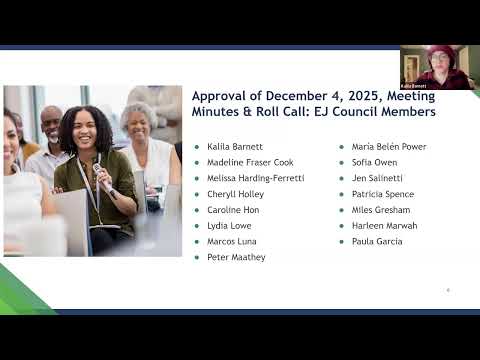
Massachusetts details decision framework for Clean Energy and Climate Plan and asks Environmental Justice Council for input
Summary
State decarbonization staff presented a draft decision-making framework and multi-scenario modeling approach for the 2035 Clean Energy and Climate Plan, emphasized equity and uncertainty analysis, and invited EJ Council feedback and hybrid community engagement.
Massachusetts decarbonization officials on Wednesday presented a draft decision‑making framework and modeling approach for the 2035 Clean Energy and Climate Plan (CECP) and asked the Environmental Justice Council to help shape how equity and affordability are woven into policy choices.
"It's due on January 1st, 2028," said Melissa Mittelman, Assistant Secretary for Decarbonization, noting the state has only a limited window to finalize modeling, policy packages and implementation responsibilities. Mittelman described the CECP as the Commonwealth's roadmap to meet legislatively mandated emissions limits across electricity, transportation, buildings, industry and natural and working lands.
Oleander Stone, director of Climate Equity and Environmental Justice, said the team intends to develop a vendor‑supported decision framework that evaluates tradeoffs across health, equity, affordability and other priorities. "It's a place of intersectionality," Stone told council members, describing plans to model multiple scenarios — including business‑as‑usual and policy‑package pathways — and to incorporate uncertainty analysis for technology and federal policy shifts.
Presenters said the CECP will assess not only how many electric vehicles or heat pumps are needed but also how candidate policies affect monthly energy bills, burdened communities and benefits distribution. "We must adopt goals and set a strategy for the role of our natural and working lands," Mittelman said, and staff emphasized that equity should be woven through the planning process rather than treated as an isolated chapter.
Council members asked how the team will distinguish priority end‑goals (for example, health and equity) from tactics such as load management, and whether the modeling would reflect real‑world constraints. Patricia Spence asked whether the uncertainty analysis will include technology changes as well as funding and federal policy shifts; staff confirmed the framework will consider technology, cost and barrier scenarios.
Breakout group report‑backs raised concerns about accessibility and community engagement: remote participants and council members urged plain language (several said "decarbonization" is jargon that may not resonate with everyday residents), recommended clearer pathways for communities that repeatedly bring local problems to state attention, and asked that modeling account for local lived experience, not only academic scenarios.
Mittelman also told the council the administration plans to release a climate metrics "report card" the following day to illustrate interim technical benchmarks; she noted that the full 2025 emissions inventory will lag by roughly two years and that formal statutory compliance assessments follow a separate schedule.
Staff said they plan further consultations with the council, the Implementation Advisory Committee and other advisory bodies as they onboard a vendor, refine modeling, and draft the CECP for public review. The council's next meeting was scheduled for April 9 in Orange, where staff plan to return with more detail on petition and engagement processes.
The presentation and public comment period focused council attention on two central tasks for the CECP: how to measure and distribute benefits equitably, and how to present technical choices in ways that are accessible to communities whose daily lives are affected by energy and land‑use decisions.