Get Full Government Meeting Transcripts, Videos, & Alerts Forever!
Get email alerts on the School Safety topic
No spam. Unsubscribe anytime.
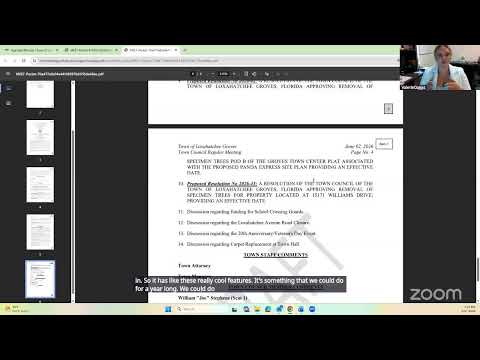
Town discusses who will pay for school crossing guards after PBSO pullback
Summary
Council members pressed staff for details after PBSO said it will stop providing crossing guards at Loxahatchee Groves Elementary; staff proposed using about $24,000 in speed-camera revenue as a temporary funding source but estimated full-year cost at $70,000'$80,000. Council asked for more data and legal guidance before committing.
Council members on the Town of Loxahatchee Groves workshop raised urgent questions about who will pay for school crossing guards after the Palm Beach County Sheriff's Office (PBSO) indicated it would stop supplying the positions at Loxahatchee Groves Elementary once the school year ended.
Jeff (staff) told the workshop the town has collected approximately $24,000 from the Redspeed speed-camera program and that staff was "relatively comfortable in recommending that the monies that we have received thus far from Redspeed could be utilized for that purpose" if the town assumes responsibility. Jeff said PBSO and the sheriff's legal team were still reviewing the basis for PBSO's decision and staff was coordinating with the school district and county to determine statutory obligations.
Council members said the topic raises child-safety concerns and budget questions. One member estimated the annual cost for four crossing guards at roughly $70,000'$80,000 and noted that two of the existing crossing posts are on town-owned property while the other two cross Okachobee Boulevard outside the municipality's limits, complicating responsibility and cost-allocation.
Several council members urged caution because of legal uncertainty about the use of speed-camera revenue: staff cited a prior regional case where red-light camera revenue drew legal challenges and cautioned that some claims had been treated as voluntary payments. For that reason, staff recommended gathering further legal analysis before committing the funds permanently.
Council direction and next steps: members debated whether to act quickly to hire a vendor or to wait for firm guidance. One proposal was to table the item to July to allow staff time to obtain a legal opinion from PBSO and the county and to include potential crossing-guard funding as part of the upcoming budget discussions. Staff will continue discussions with PBSO and report back; the town may also evaluate vendor-provided crossing-guard services as a short-term option.
The workshop did not produce a vote or binding directive; council will revisit the matter when staff returns with additional legal and budget information.