Get Full Government Meeting Transcripts, Videos, & Alerts Forever!
Get email alerts on the Parking topic
No spam. Unsubscribe anytime.
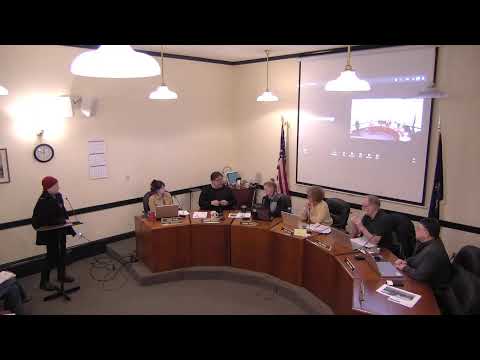
Select Board sets FY27 paid-parking parameters after lengthy public debate
Summary
After extensive public comment on safety, resident permits and employee impacts, the board directed staff to implement a paid-parking season starting Memorial Day at $2/hour, generally 10:00–18:00 with the public-landing zone enforced to 20:00, unlimited extensions at the same rate, and staff follow-up on resident-permit options.
The Select Board debated changes to Camden’s paid-parking program for FY27 after a presentation from Holly Anderson, the town liaison to the parking working group, and extended public comment from business owners and residents.
What the board settled on: Members moved to keep the new season limited-changes for 2026 to collect a full set of operational data, and they approved parameters that will guide staff programming and budget planning: start the paid-parking season on Memorial Day and run through Oct. 31; keep a base rate of $2 per hour; standard enforcement hours will be 10:00 a.m.–6:00 p.m. (Monday–Saturday) and noon–6:00 p.m. (Sunday); the public-landing zone will remain a separate zone and be enforced until 8:00 p.m.; customers may extend as needed (unlimited extensions) at the same hourly rate. The board also directed staff to research permit options (including low-technology resident passes) and to return with recommendations that do not overcomplicate implementation.
Public concerns: Dozens of residents and business owners spoke in favor of collecting more season-long data before raising rates or expanding enforcement hours. Speakers raised four recurring concerns: (1) workers and residents in nearby streets may be disadvantaged without resident permits; (2) employees could incur substantial daily parking costs if forced to pay for entire shifts; (3) some neighborhoods worry about spillover parking if restrictions apply near their homes; and (4) safety and lighting on walking routes from peripheral lots were cited as a barrier to using free lots.
Revenue and enforcement: The working group presented revenue scenarios showing a wide range depending on rate and hours; the $2/hour option yields a modest revenue projection while a $3/hour model projects materially higher receipts. The board emphasized starting 2026 as a full data-collection year before making more complex zoning and pricing changes; enforcement staffing and permit logistics will be finalized by staff with the vendor and brought back to the board.
Next steps: Staff will proceed with machine programming and vendor setup aligned to the defined parameters, collect a full season of usage data, and return mid-season and after the season with analysis and potential permit proposals, including options for resident or employee permits and low-tech sticker solutions.