Get Full Government Meeting Transcripts, Videos, & Alerts Forever!
Get email alerts on the Advanced Nuclear Reactors topic
No spam. Unsubscribe anytime.
BWXT outlines micro- and mid-scale reactors and TRISO fuel production in Lynchburg
Summary
BWXT senior director Josh Parker told a Virginia nuclear authority meeting that the company is building a 20-foot ISO-container micro-reactor for the U.S. military and expanding TRISO fuel production in Lynchburg to support Project Pelle and other advanced reactor projects.
BWXT senior director Josh Parker told the Virginia Nuclear Authority that the company is building a transportable micro-reactor and expanding TRISO fuel manufacture in Lynchburg to support both defense and commercial demonstrations.
"We are building a reactor that fits in a 20 foot ISO container," Parker said, describing Project Pelle as a 1-to-5 megawatt electrical system intended to replace diesel generators at forward operating locations and provide years of on-site energy without a fuel logistics tail. Parker said BWXT expects to ship fuel to Idaho National Laboratory "very shortly" and anticipated an announcement in the coming months that tests there have succeeded.
Parker described the micro-reactor as horizontal and transportable by truck, train and aircraft and said it is designed to supply operational energy where diesel resupply is risky or costly. He also outlined a larger fixed-site design, called Banner, sized at roughly 22 megawatts electric and 75 megawatts thermal for applications such as mining operations that require both heat and electricity and certain midscale or edge data centers.
"You can't have reactors without fuel," Parker said while explaining TRISO particle fuel (a uranium oxycarbide kernel with multiple protective layers). He described TRISO particles as roughly "the size of a poppy seed" and said the manufacturing line in Lynchburg is producing particles for Project Pelle and other advanced reactor efforts. Parker said BWXT has added production capacity and a 10,000-square-foot facility in Lynchburg to meet anticipated demand.
During questions, Parker said that public concern about waste is consistent across audiences. "Waste comes up every discussion that you have out in the public," he said, and noted the United States currently relies on interim dry cask storage at reactor sites while a federal final disposal solution remains unresolved.
Authority members pressed Parker on state policy lessons from other jurisdictions. Parker pointed to examples in North Carolina, Wyoming and other states where utilities or regulators clarified recovery mechanisms or adjusted spent-waste policy to make deployment feasible. He urged state officials to consult a broad set of vendors before codifying narrowly tailored incentives.
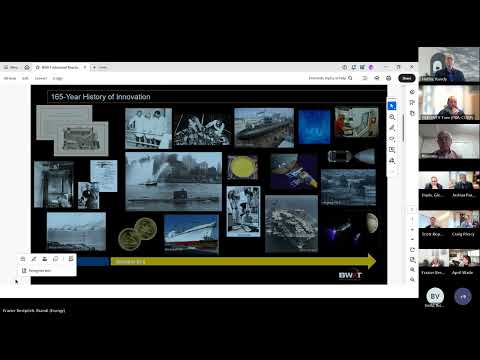
The presentation highlighted BWXT's long industrial history, its five major U.S. manufacturing sites and work on naval reactors, defense micro-reactors and commercial advanced-reactor fuel. Parker framed BWXT's Lynchburg operations as central to the company's TRISO capability and to planned demonstrations in the early 2030s.
Looking ahead, Parker said Project Pelle is intended for operational military energy and that Banner-style fixed installations could be competitive in off-grid industrial settings or for certain data-center use cases where small, resilient power and heat are required.