Get Full Government Meeting Transcripts, Videos, & Alerts Forever!
Get email alerts on the Short Term Rentals topic
No spam. Unsubscribe anytime.
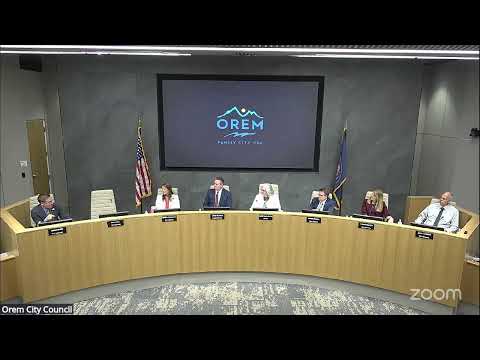
Orem council orders two competing short-term rental ordinances after lengthy work session
Summary
After a full presentation and extended Q&A, Orem staff were directed to draft two competing ordinances — one limited to owner-occupied short-term rentals, the other allowing limited non-owner-occupied units — and return to the council on June 23 for formal consideration.
Orem, UT — The Orem City Council spent the first hour of its May 26 work session on a detailed staff presentation about proposed limits and enforcement for short-term rentals, and directed staff to draft two competing ordinances to return on June 23.
City planner/staffer Jake presented a package that included a proposed five-day dormancy requirement — that a short-term rental be vacant for five days in any given monthly period — and a “legacy status” provision for operators who can prove continuous operation before Jan. 1, 2025, maintenance of a rental-dwelling license, and tax compliance. “Requiring five days that are non-consecutive should not impact any short-term rental operator hugely financially,” Jake said, arguing the measure would help prevent the use of short-term rental listings as de facto long-term or student housing.
Why it matters: Council members said they remain divided about the city’s broader approach: some favor maintaining a near-total prohibition, some prefer allowing only owner-occupied rentals, and others support a tightly capped program permitting a small number of non-owner-occupied units. Many said enforcement capacity and fee structures must align with whichever policy the city adopts. Jake told the council estimated enforcement staffing and overhead could range from roughly $141,000 for one planner plus one enforcement officer to about $210,000 for additional staffing; he advised conducting a fee study to calibrate initial licensing costs.
Key points and disagreements
- Dormancy rule: Staff recommended a nonconsecutive five-day vacancy each month to preserve the character of neighborhoods and frustrate attempts to use STR listings for long-term student or group housing. Jake said the benchmark was based on industry occupancy estimates and would still allow a high utilization rate for bona fide hosts.
- Legacy/Grandfathering: Staff proposed a legacy-status pathway for operators who can show prior operation before Jan. 1, 2025, and who meet documentation and tax requirements. The status would exempt qualifying properties from caps or density limits but would not create transferable land-use rights. Council members pressed staff about how transfers, sales, or trusts would affect legacy status; staff’s draft would require a new owner to reapply rather than automatically inheriting rights.
- Owner-occupied vs. non-owner-occupied: Councilors discussed a two-tier approach. One ordinance to be drafted will allow only owner-occupied STRs; the other will allow owner-occupied STRs plus a limited number of non-owner-occupied units, subject to geographic dispersion, a citywide cap (members floated 20 as an example), and strict enforcement guardrails.
- Enforcement and fees: Staff said effective enforcement will add ongoing workload for community development and code-enforcement officers and recommended that STR fees cover those costs. Councilors asked for fee transparency and asked staff to work with the city attorney and a fee-study vendor (LRB) to validate any proposed charges.
- Evidence and verification: Council members flagged the practical challenge of verifying complaints (for example, late-night noise) when police are busy. Staff suggested using NIT/code officers for follow-up and relying on corroborating evidence (video, officer corroboration) when available.
Next steps: Council directed staff to prepare two competing ordinance drafts for the June 23 work session: (a) an owner-occupied-only STR ordinance and (b) an ordinance allowing owner-occupied rentals plus a limited, tightly controlled number of non-owner-occupied licenses (with legacy-status options to be included only if the council chooses to allow non-owner-occupied STRs). The council asked that drafts and supporting slides be circulated at least eight days ahead of the June 23 meeting.
What to watch: The June 23 work session will be the next public milestone. The city has not yet adopted final fee levels, exact cap numbers, or a final legacy-status definition; those details will be in the ordinance drafts and supporting materials returned to council.
Attribution: Quotations in this story are taken from the May 26 city council transcript and are attributed to the speaker in the meeting record. “Requiring five days that are non-consecutive should not impact any short-term rental operator hugely financially,” staff presenter Jake said during the meeting. The council’s direction to draft two ordinances was issued collectively during the work session.