Get Full Government Meeting Transcripts, Videos, & Alerts Forever!
Get email alerts on the Special Events Ordinance topic
No spam. Unsubscribe anytime.
West Vincent supervisors review revised special-events ordinance; organizers seek clearer rules for horse shows and small gatherings
Summary
At a July 1 workshop, West Vincent Township officials discussed a revised special-events ordinance that removes a 50-person threshold and ties permit requirements to multiple impact criteria; horse-show organizers and residents urged clearer definitions, exemptions for recurring small events and flexibility on 45-day application timing.
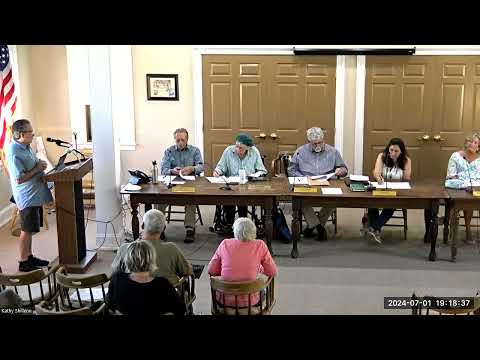
West Vincent Township supervisors and staff reviewed a revised special-events ordinance during a July 1 workshop, with residents and event organizers urging changes to protect long-running local horse shows and to avoid imposing burdensome requirements on small community gatherings.
The board’s chair opened the discussion after staff posted a clean version of the draft ordinance to the township website, saying the revisions largely clarify enforcement and reporting lines rather than introduce new substantive rules. “We did post the updated ordinance … there’s really nothing substantive that changed other than like who reports to who,” the chair said.
Dave, a township staff member who summarized the changes, said the draft removes an arbitrary 50-person threshold and instead uses multiple criteria—such as closing a public right-of-way, use of special effects, staging, or interference with traffic—to determine when a special-event permit is required. “We removed the reference to 50 persons … it just says where people are likely to attend is one of the criteria,” Dave said.
Matt, the township’s code enforcement officer, said the ordinance consolidates standards already found in the International Fire Code into a single local process for special events, noting the fire code now contains much of the relevant detail for tents and membrane structures. “There’s really nothing that we’re changing that wasn’t already there … this makes it easier for us to enforce it,” Matt said.
Residents and organizers raised several specifics they said need clarification. Barry Del Libero, who identified himself with a local address and said he regularly holds gatherings of 150–250 people, asked whether private, invitation-only events on private property would be caught by the ordinance. Staff replied the draft is not intended to regulate purely private gatherings that do not impact public ways or services, but that public fundraisers or events that draw outside attendees could trigger permitting requirements.
Organizers of recurring horse shows and small community events objected to provisions they said could require excessive upfront information or fees. One organizer said asking for full legal names and addresses of “all sponsors” could deter donors and create FOIA exposure. “The intent of the word sponsor here is someone who organizes it, not someone who just pays $500,” a speaker said, urging replacement of “sponsor” with clearer terms such as “organizer” or “person in charge.”
The draft requires applications “not less than 45 days” before promotion and advertising takes place; several commenters said that timing, when tied to the date of advertising, would be unworkable for some events whose dates appear on federation calendars or similar listings months in advance. Staff and board members suggested tying the clock to the event date or the first reasonable notice of the event rather than to any calendar posting.
Safety and operational details were a central focus. Speakers urged clear rules for traffic control—distinguishing between qualified personnel who may direct traffic and private flaggers who may only slow or stop traffic—after past events hired firms without requisite authority. Organizers also pressed staff to clarify how tent size is measured for inspection and fees: the draft’s 20-by-20 example prompted debate over whether stakes and anchoring should be included in the area calculation. Matt said his enforcement practice has sometimes included anchoring elements and recommended codifying the interpretation to avoid repeated disputes.
Staff confirmed that plans submitted for permits will be reviewed by the township code official, the police department and public works, and that permits may include agreements requiring organizers to reimburse township costs for additional police or public-works services when necessary. The draft also references adherence to the 2018 International Fire Code and local building and park rules.
Multiple participants proposed administrative fixes to reduce burdens on long-running, repeat events: an omnibus permit or standing site plan for recurring small shows (for example, multiple horse shows that do not change layout year to year), a simple site map requirement for small events, and a process for staff to work with organizers rather than requiring every detail up front. “If Matt comes to a show and sees what all the little shows are all about, I think we can figure out how to come up with… exclusions,” one organizer said.
Where legal questions arose—such as whether an agricultural stormwater exemption would apply to a proposed new riding ring—staff said they had consulted the solicitor and would follow up. The code enforcement officer and staff indicated they would revise the draft to reflect feedback, repost it for public review and return to the board for further discussion before advertising the ordinance for approval.
The workshop concluded with staff agreeing to refine language on sponsors/organizers, the 45-day timing trigger, tent measurement and fee clarity, and to consider omnibus permitting for recurring small events. No formal vote was taken at the workshop; staff said they would post a revised draft and schedule a future meeting for further review.