Get Full Government Meeting Transcripts, Videos, & Alerts Forever!
Get email alerts on the Methane Emissions topic
No spam. Unsubscribe anytime.
Resident Paul Nipold tells advisory committee LandGEM run shows roughly 2 billion cu ft of fugitive landfill gas in 2025
Summary
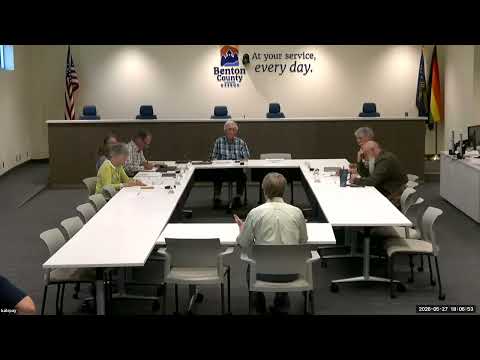
Paul Nipold, a Sub Creek Valley resident, told the Benton County Disposal Site Advisory Committee that October LandGEM model runs estimate ~3.6 billion cubic feet of landfill gas generated in 2025 and that about 1.6 billion cubic feet were captured, leaving approximately 2.0 billion cubic feet as fugitive emissions; the committee asked for the underlying data for verification.
Paul Nipold, a Sub Creek Valley resident, told the Benton County Disposal Site Advisory Committee that October LandGEM model runs for Coffin Butte show ‘‘about a 103,000,000 cubic meters, which is about 3,600,000,000 cubic feet per year’’ of landfill-gas generation and that roughly ‘‘1,600,000,000 cubic feet of that was captured,’’ leaving “about 2,000,000,000 cubic feet per year” escaping as fugitive landfill gas.
Nipold said those results, which he described as ‘‘astounding’’ and ‘‘huge,’’ are based on the LandGEM spreadsheet model the U.S. EPA uses to estimate landfill gas generation and on franchisee and engine-generation reports; he offered to provide the October runs and to work with the committee or its odor-and-methane subcommittee to produce a more formal technical paper and to help the county evaluate mitigation options.
Committee members pressed for context and comparators. One member asked whether the consultant or other analysts used the same inputs; Nipold said the estimates agreed with figures prepared by a former DEQ air-quality manager, and that those historical reviews indicated fugitive releases have exceeded one billion cubic feet per year since about 2019.
A county/owner representative declined to accept or rebut the figures without seeing the underlying files. ‘‘I can’t rebut anything. I don’t have information to say or provide it,’’ the presenter said, and suggested LandGEM results can have substantial error depending on input assumptions; the committee asked Nipold to provide his model runs and supporting documents for review.
Why it matters: committee members said the numbers — if validated — would help explain the frequency of odor complaints and inform evaluation of gas collection efficiency, monitoring priorities and potential mitigation steps. The committee voted to request the technical materials be circulated and to consider follow-up analysis by county staff and subcommittees.
What’s next: Nipold offered to coordinate with county staff (Bailey) to deliver the LandGEM runs and a summary paper. The advisory committee agreed to add review of those materials as an action item and to follow up with technical questions to the owner and DEQ as appropriate.