Get Full Government Meeting Transcripts, Videos, & Alerts Forever!
Get email alerts on the Permit Parking Program topic
No spam. Unsubscribe anytime.
Adams County staff say permit‑parking pilot is working but expansion will require more staff or new funding
Summary
County staff reported the five‑year pilot near Regis University has issued about 600 resident permits, achieved a 4:1 warning‑to‑citation ratio and reduced officer hours to about eight per week, but said adding more districts will require additional FTEs or revenue and that resident approval must meet a 60% household threshold.
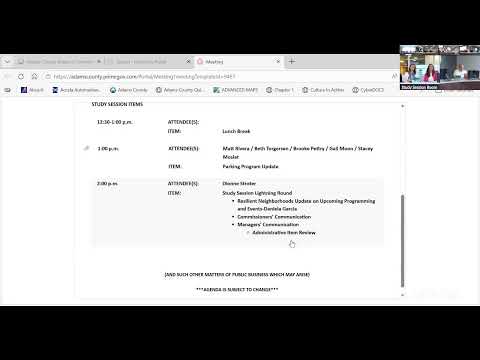
Stacy Moslet, Neighborhood Services Manager with Adams County Community Safety, Well‑Being, told commissioners the county’s pilot residential permit‑parking program — launched Nov. 1, 2021 after the board adopted Ordinance 16 — is meeting its goals in the pilot district near Regis University.
Moslet said the program has issued “over 600 residents [permits],” that the office takes an education‑first approach (a warning‑to‑citation ratio of about 4:1) and that officer time in the district has declined to “about eight hours a week,” which staff view as a steady state for a well‑adopted district.
Board context and why it matters: the county commissioned a Walker Consultants study in 2018–19 that assessed 15 neighborhoods in southwest Adams County and identified four candidate neighborhoods for active parking management. The board adopted Ordinance 16 to authorize permit districts; staff said none of the original study areas met the ordinance thresholds but Berkeley (the pilot area) had the most complaints and became the pilot. Moslet said the county has since received two formal neighborhood requests for new districts; staff ran the prescribed studies in cooperation with Public Works and found neither met the ordinance’s 60% household approval threshold.
How the program works: permits are virtual and tied to license plates; each household receives two free resident permits and two physical visitor hanging tags valid for 72 hours. Households may add up to four additional permits on a sliding scale ($5, $10, $25, $50), and parking violations are cited at $21 each (up to three citations in 24 hours), payable within 20 days or referred to court.
Staffing and capacity limits were a focal point of the discussion. Moslet said the board provided one FTE split 50% to parking and 50% to general code duties. Using a code officer’s full annual capacity (~1,450 working hours) as a baseline, staff presented projections showing that the current single district is sustainable; adding a second district would reduce spare capacity to roughly 660 hours, a third district to about 210 hours, and a fourth would produce a deficit. Moslet summarized: “One additional district is absorbable. Anything beyond that requires an additional FTE.”
Commissioners pressed staff on how the 60% household threshold is calculated and whether it is practical given low mail/survey response rates. Moslet and others said the ordinance counts households in the affected area as the denominator (not respondents), that surveys are multilingual and include QR codes, and that county attorneys and staff set the 60% bar to prioritize neighborhood buy‑in and to avoid disproportionately impacting multi‑generation households.
Legal and funding questions also arose. One commissioner asked whether the county can impose impact fees on large new apartment developments when state statute prevents requiring on‑site parking; staff said impact fees are typically one‑time charges and advised legal analysis to determine whether such fees could cover ongoing program costs. Commissioners proposed alternatives to ease on‑street demand, such as reviewing driveway standards (staff said the first two residential parking spaces must be a hard surface; an additional space may use 3/4" rock) and considering targeted outreach or curbside management plans in transit corridors.
No formal vote was taken. Staff asked whether the board wanted CSWB to pursue evaluations in the next 12 months and, if so, where to focus; several commissioners signaled interest in pursuing additional districts along transit corridors but emphasized the need for a plan to fund staffing and to protect equity for residents.
The county plans to circulate Ordinance 16 and follow up at a future meeting with additional analysis on staffing, funding options, and any proposed tweaks to the approval process.